Ugh…politics…

Rarely if ever do I blog about politics but, then again, few things rile me up as much as blasphemy or false messiahs. Since I just posted this on Facebook, I figured I might as well post it here too:

I don’t like to post political stuff, but I feel compelled to speak up. No election in my lifetime has frightened me as much as this one, but today topped it all for me.

Christians I know and like are posting links to a blasphemous, scary article and — rather than denouncing it or getting offended — are actually voicing agreement with it. In the article, the author quotes one of my all-time favorite Scripture passages, which is from Isaiah 40. He quotes verses 30-31 in this manner:

“Even the youths shall faint and be weary, And the young men shall utterly fall, But those who wait on the Lord Shall renew their strength; They shall mount up with wings like eagles, They shall run and not be weary, They shall walk and not faint.” 

Then the author proceeds to claim, “It’s almost like God created this verse for Donald Trump and this moment in history.”

That awful statement alone should horrify any student of Scripture or anyone who claims to believe in the God of the Bible. But it gets worse. 

I have no idea who Wayne Allyn Root, the author of this travesty, is. At the beginning of his article, he identifies himself by writing: “I am a Jew turned evangelical Christian. I am also a passionate supporter of Donald Trump.” I would argue, based on this article, that he is no longer an evangelical Christian but now believes in Trump as his messiah. Mr. Root seems to believe that it is now Trump, and no longer God, who renews our strength, and who enables us to mount up with wings like eagles. 

I wish I was kidding or that Mr. Root had written a tasteless satire, but unfortunately that doesn’t appear to be the case. In his “message for Christians”, he tries to convince us that “Trump is our energy”; “Trump renews our strength”; “With Trump we mount up with wings like eagles”; and, “With Trump we run, we are not weary”.

Sorry, those of my friends who are Trump fans, but that sounds like blasphemy to me. Trump is not God. Isaiah 40:31,32 is not a prophecy that Trump is fulfilling. “The Donald” may think he is America’s savior, and he may have convinced you of that, but he is not our messiah, not our God, not our Savior.

I’m beginning to think that this election is causing people to take absolute leave of their senses. What sort of bizarre hold does Trump have over this misguided and deluded author that he would write something so terrible while claiming to be a Christian — and why are my Christian friends not outraged at what he has written?

You can read the blasphemy in context here: http://m.townhall.com/columnists/wayneallynroot/2016/06/24/a-message-for-christians-about-donald-trump-n2182796

Treasure in the Field, part 3 | Fiction Friday

[Begin with part 1 here.]

Three days later, he heard the king’s voice again, this time early in the morning as he was folding up his simple sleeping pad in the hut where they now stayed. His wife was outside, getting fresh water from the nearby spring and, when she returned, she found him face down on the floor.

“You heard the king’s voice,” she said quietly. He was struck by her calmness as she explained, “I have been hearing him more and more lately. Soon it will be time for me to ride to him.”

“What about me?”

“I don’t know. What did the king say?”

“He just called my name.”

She nodded. “Wait. Wait for his voice.”

So they waited. Their days were filled with mediation, study, vigorous exercise, and hikes through the surrounding countryside. Sometimes his wife would check to make sure her garments and travel supplies were ready. Their evenings were filled with long talks by the fireside, their nights with tenderness.

In the meantime, his mind filled with questions he dared not ask.

Spring came. One morning a beautiful white stallion appeared in the clearing outside their door. His wife greeted it like a long lost friend, throwing her arms around the horse’s neck in an embrace, kissing it between the ears, and then flinging herself on its back before galloping off.

It was the first time he had seen her ride. He didn’t even know if she had ever been on a horse before in her life, but now she looked as if she was finally doing what she had been born to do.

His heart ached.

She returned an hour later, her face radiant and her hair gloriously windswept. When had her grey strands turned to silver? he wondered. Surely not during her ride…

“I leave tomorrow at sunup,” she announced.

He couldn’t answer.

“I have never loved you as much as now, but I love the king more. Besides, he’s the one I serve. I’ve waited my entire life for this. He’s calling me — can you imagine? me! — and I get to go.”

Again, he couldn’t answer.

Later, they both wept. They spent the night in each other’s arms.

After a hurried pre-dawn breakfast the next morning, she put on her travel garments. He had never seen such clothing, and he was filled with wonder. She wore a flowing white dress, far more beautiful than the one she wore at their wedding and, over this extraordinary dress, she wore armor. When he asked her about her armor, shield, and sword, she answered somberly, “I thought you understood. It’s not just a journey. The king will be leading us into battle.”

Finally he couldn’t take it any more. “Do you think the king will ever call for me?” he asked desperately, feeling as if his heart was about to break irrevocably. “I’ve followed your example. I’ve given up everything. I sold our home and my business, and I gave away everything I couldn’t sell. I’ve meditated; I’ve exercised; I’ve walked countless miles through what seemed like endless forests and deserts. I’ve read and studied and learned everything I could. I’ve waited. I’ve listened. I don’t know what else to do!” Putting his hand on her shoulder, he cried, “I’ve given up everything, lost everything — and now I’m losing you too!” He forced himself to choke back the sobs. “I have nothing left.”

“Nothing but the king,” she reminded him gently. “And he’s all that matters anyway. Everything else was futile and worthless compared to him. It’s as if we spent it all to buy the greatest treasure there is. Wasn’t it worth giving it all up just to hear his voice?”

“Yes,” he paused, only to go on, “but now that I’ve heard it, how can I possibly be content staying here? I want to go to him! I want to ride with him!”

They clung to each other and wept yet again. He urged her, “Please give a message to the king. Tell him…tell him that I would consider it the highest honor if he would call me to be his servant.” She wiped his tears, kissed him one last time, and mounted her horse, shouting, “Wait for the king! Listen for his voice!” He watched her ride off, and he knew that he would never behold a more beautiful sight than this fierce warrior bride on her white steed, her banner wafting high above her head in the breeze.

She was gone. He whispered, “Nothing but the king”, fell to his knees, put his face down in the dirt, and wept as he had never wept before. He wondered if he would keep weeping until he died.

And then he heard hoofbeats.

It couldn’t be. Please don’t choose me over the king, he wanted to scream at the same time that he hoped beyond hope that he would see his wife when he lifted his tear-stained face from the dirt.

Unbelievably, she had returned, this time leading another horse. “It seems the king thinks you’re ready,” she said. “He left you this horse with everything you need for the journey.”

The entire time he rushed about washing his face, dressing in his travel garments, putting on his armor, and preparing to leave, words and tears tumbled out of both of them. It was as if two dams had burst suddenly, and everything gushed out everywhere in wild torrents. They sang with exuberant joy, laughed with delight, cried with thanksgiving, and even shouted with excitement.

“Can you believe we get to ride together?”

He was ready. They hugged and kissed, and mounted their horses. Then they heard it together — the voice of their king, calling them both by name, calling them to ride, calling them to the journey, calling them to their great adventure, calling them to battle, calling them to die, calling them to him. They lifted their banners high and shouted, “To the king! Let’s ride!”

And they rode.


“The kingdom of heaven is like treasure hidden in a field, which a man found and covered up. Then in his joy he goes and sells all that he has and buys that field.” Matthew 13:44
The elephant in the room | Marriage Monday

Almost a year ago, I stumbled across a blog post dealing with the issue of marital rape, and whether a husband is in the wrong for insisting on sex even when it is painful to his wife. Frankly, the post along with a number of comments — and pretty much everything I read on the blog — is so problematic and disturbing that I don’t even want to link to it.

Even though other comments have been approved since then, mine is still awaiting moderation, about eleven months later:

This is what I see as the major issue — the elephant in the room that no one is fully addressing, although a few have hinted at it.

We cannot expect an unbelieving husband to want to love his wife as Christ loves the church. But the real elephant in the room? Most Christians have no idea what love means. They think it means leadership and a skewed, worldly view of authority. We gloss over the part where a husband is to lay down his life sacrificially for his wife, or we romanticize it by saying he should take a bullet for her should armed intruders ever enter their home.

Really? What husband in his right mind would do that if he is unwilling to forego sexual pleasure when his wife is in pain? But it’s nice to pretend he would, nice to pretend he would be a hero — because he knows the likelihood of that scenario is next to zero.

Our culture has made an idol of sexual pleasure, especially male sexual pleasure, and in order to avoid the appearance of bowing to the same idol, we have enshrined this as a need. We have bought into the lie that sex is mostly about meeting this all-consuming NEED on the part of the husband, rather than about unity, intimacy, and procreation.

Men no longer see sex as the physical expression of the sacrificial gift of themselves that they give to their wives in marriage. If they did, they would not avoid true intimacy (emotional and spiritual) in marriage, and they would abhor the very thought of asking the wife they love to give them a blow job while she is recovering from childbirth.

Sometimes the sacrifice men might be called to give to their wives is a foregoing of selfish sexual pleasure. But we don’t want to hear that.

The elephant in the room is that we have no idea what love means. We may sing songs about amazing grace and the love of Jesus, but our hearts remain hard, selfish and idolatrous. That is why our lack of compassion is so painfully obvious to everyone but us, why we can demand wives submit to demeaning and painful sex, and why we criticize women who suffer pain during intercourse for being selfish, childish, and refusing to go to doctors. (An aside: such statements betray woeful ignorance. Sciatica and chronic coccyx pain — just to name two potentially debilitating and devastatingly painful conditions off the top of my head — are not easily fixable.) We teach husbands that their compassion should be limited and fleeting, and should run out if their wives suffer ongoing pain. After all, the idol of sexual pleasure rules our hearts, not love.

May God have mercy.

Finding joy | Celebration Sunday

Maybe it’s just my temperament…after all, God made me to be that 3 year old who could skip happily through the house singing my made-up song of “Life is miserable!”…or maybe it’s my oblivious non-attention to detail that keeps me from seeing every imperfection and flaw…or maybe it’s being raised by parents who modeled gratitude rather than whiny complaining…or maybe it’s because so much of my early childhood was idyllic and happy…or maybe it’s because a friend once encouraged me to look for a blessing every day…or maybe it’s because I’ve never grown up enough to completely lose my childish sense of wonder…or maybe it’s because I need joy and beauty so much, almost as much as I need food and water…but it takes a lot — as in a LOT — for me to remain in a constant state of unhappiness for very long.

Yes, it seems contradictory. After all, I am no stranger to grief or sorrow. I am the same person who once penned reams of poetry with lines like, “melancholy has stolen my heart”, and who described myself as a “child of sorrow” in a never ending gloomy rain. I’ve experienced clinical depression so severe that it made me overcome my extreme aversion to antidepressants. Despair has almost killed me. Literally. More than once.

But joy always broke through.

Always.

The darkest of nights has always, eventually, been followed by a morning when joy came. That “eventually” may have taken excruciatingly long. Sometimes it was a somber joy. Sometimes it involved some initial teeth-gritting followed by an amazement that such great sorrow, and such heights and depths of joy, could exist in the same heart and mind in the very same instance.

But maybe it’s not me at all. Because the bottom line is that I can’t praise God for very long — I mean really praise Him rather than mouthing words — without remembering what kind of God He is. I find my perspective changing from “woe is me” to realizing that, even in the most horrific of circumstances, I have reasons for thanksgiving, even if I can’t think of one beyond, “Heaven will be better than this nightmarish horror.”

But then I remember Jesus. And He melts me. And He opens my eyes. Gratitude comes trickling into my spirit as I begin remembering Scripture passages that speak to whatever pain it is that I’m currently suffering. It may not happen quickly enough for me, but gratitude re-orients my thoughts and feelings. Maybe I am just unusually blessed, but it is rare (impossible?) for me to sit in God’s presence for very long without feeling enormously thankful for His extravagant, scandalous grace and generosity towards me.

Eventually more of my feelings follow. There have been valleys in my life, even valleys of the shadow of death. But, as Corrie ten Boom loved to remind us, there is no pit so deep that God’s love is not deeper still.

Today, incredible as it seems even to me, I thank God for the pits that threatened to consume me, because God’s love won out, every time. Even when I doubted or denied Him, when I wandered or ran away, He never gave up. Besides, for every pit there have been mountaintops — a few times, I have felt joy so overwhelming, so extreme, so powerful, so beyond description, that I thought if it lasted any longer with such intensity, my heart would give out and I would die. Seriously.

Because I choose to be grateful, today I choose joy. Today I choose happiness. Today I reach out with trembling, eager if still somewhat inhibited, weak and puny little hands towards the abundant life God keeps showering on me. How can I walk with Him, talk with Him, and listen to Him without — once in a while — experiencing a joy that spills over into a happiness that at least borders on giddiness?

A dear friend of mine promised me that, when I first recognized my true freedom in Christ, I would feel almost giddy about it. He was right; I still remember the moment it hit me and I wrote him an email that ended with, “Excuse me while I go out and dance in the streets.”

I know, I know. Happiness should not be our goal. It is a fleeting emotion. In many circumstances, it would be completely inappropriate to feel happy. We should be sober-minded, seek holiness, die to self, etc., etc.

But today I choose to celebrate. I probably won’t dance in the streets, because I’m still too shy and inhibited, but I’m not going to pretend that it’s somehow more spiritual to ignore all of God’s present blessings and put on a serious face just because I’m not in Heaven yet.

Little 3 year old me had it right. Life is miserable. Or at least it can be sometimes. But that’s no reason not to sing and dance some of the time — because God is good.

This is an adapted version of a previous post.

What am I feeding? | Faith Friday

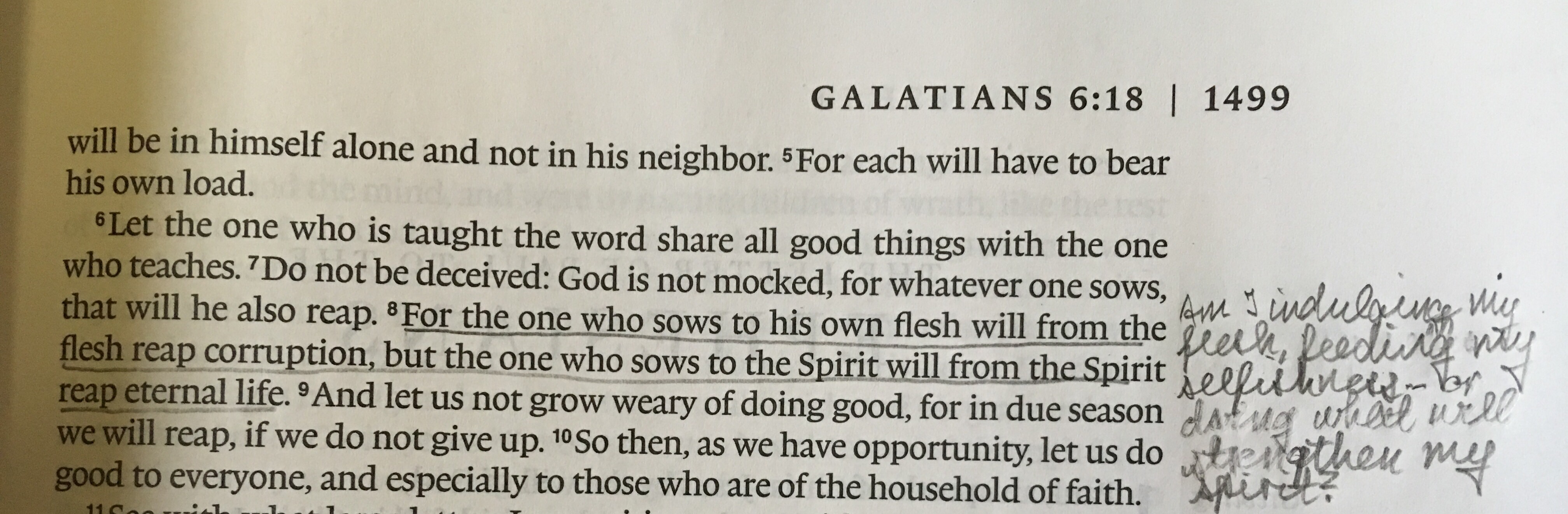
My Lectionary reading this morning included a passage from Galations, and one particular verse jumped out at me.

For the one who sows to his own flesh will from his own flesh reap corruption, but the one who sows to the Spirit will from the Spirit will from the Spirit reap eternal life.

I couldn’t help asking myself: am I indulging my flesh, feeding and catering to my selfish desires, nurturing those negative aspects of my nature — or am I doing all I can to strengthen my relationship with God and to make room for the Holy Spirit in my life?

What do I want to reap? Am I sowing the right seeds, planting and tending the right crop? I can’t scatter weed seeds, and spend my time tending them and watering them if what I really want to harvest is delicious fruit.

When I engage in selfishness, why am I surprised that I keep growing more selfish, more self-indulgent, and more full of an attitude of entitlement, rather than less?

My thoughts drifted to a sermon at a camp I attended in my teens, when the pastor described our internal battle, spirit versus flesh, as a struggle between a good dog and a bad dog. Which one would be stronger? He answered by saying, “It’s the one you keep feeding.”

Be careful what you feed.

I need that reminder today.