
Rape aftermath: why I didn’t report | Survivor Saturday

Disclaimer/warning to family and friends: I know that some of you read this blog now and then, and so I wanted to warn you that this particular post might be especially sad and painful. Please consider that carefully before you continue reading. And remember that I’m OK now…in fact, much more than OK.

There has been a lot of discussion swirling around the recent verdict in the Stanford rape case. This is written in response to some of that.

In the morning, the older of my two rapists didn’t want me to leave. He mockingly and cruelly pretended as if we had just spent a lovely night together; why wouldn’t I stay for breakfast? He wouldn’t tell me where he had put my clothes, and jokingly insisted that I hadn’t been wearing any when my friend and I had come over for dinner the evening before.

Somehow I managed to find my clothes, put them on, and walk over to my apartment. No one was there. It was my first day at a new job, so I knew I had to hold myself together.

One of the legacies of the bullying and sexual abuse in my past was learning how to dissociate, how to “go away” or “make myself small” in order to separate myself as much as possible from my body. That’s how I could refuse to feel anything as I took that shower that rape survivors know all too well. To this day, I have no idea of the extent of my injuries. I was vaguely aware of upper body bruising that I accidentally caught glimpse of in the mirror. The next day, I dissociated during the exam done by my sweet, gentle, caring doctor — I still get tears of gratitude in my eyes whenever remembering him. In the shower that morning, I recall scrubbing and scrubbing, refusing to look, refusing to know, refusing to feel.

Of course I couldn’t escape every feeling. The sense of shame and filthiness was overwhelming, as was the sense that they had stolen my body. There are no words to describe what that felt like.

Somehow, I made it to work, a shattered little shell of my former self. Looking back, I am in awe of my strength. How did I manage that?

After work, I came back home, and was immediately convinced that I could not live with the knowledge of what happened to me. I came as close to killing myself as possible, saved only by my precious Jesus who presented me with a theological quandary. (Ever carried on an internal debate of Calvinism versus Arminianism with a loaded and cocked .357 magnum in your mouth and your finger on the trigger? I have.) Unable to resolve the issue of eternal security to my satisfaction, I next contemplated murder. All of this was done, believe it or not, with the utmost calm, and without a single tear.

I recognized that I might not be in the best frame of mind to decide on a course of action that would change my life forever, so I went for a drive…for hours upon aimless hours.

There is much more to the story than that, of course, but fast forward about three decades. I had decided that EMDR might be a helpful course of treatment, and my therapist was on board with the idea, even though it was outside of his scope of practice. So I found another temporary therapist, supposedly the local EMDR expert. Unfortunately, within weeks, I began referring to her among some of my friends as Bad Therapist.

Apparently she thought Donny and I had spent the past three years playing tiddlywinks or staring mutely at each other, because she insisted that I was not ready, not strong enough, to tell my story. She also saw nothing wrong with a therapist touching a sexual trauma survivor without permission, and found it weird that I didn’t appreciate this boundary violation. Supposedly all her other clients loved having their knees and thighs touched suddenly and without warning.

Knowing nothing about my rape, she asked me if I had reported it to the police. What? Why not?! Then she took issue with my answer.

Far be it from me to discourage anyone from reporting, I have nothing but the utmost respect and admiration for those who do. They are my heroes. Really and truly. But there has never been a moment in all the years since then that I have ever regretted not attempting to press charges against my rapists.

I was not strong enough.

Back then, I was only 23 years old, and it took more years than that until I was finally ready to tell my story, in as much torturous detail that I could manage, to my therapist. Donny believed me. This was not open court. He did not pick apart my account in an attempt to disprove my allegations, paint me as a liar, and try to convince a jury that I was the worst slut ever while my rapists were kind, upstanding citizens. Yet telling him what happened the night I was raped was one of the most difficult things I’ve ever made myself do, even all those years later. He had to cancel his next appointment because I was in no shape to leave his office when I was done with the telling. After that, I drove home somehow and collapsed in bed for the rest of the day, only to be tortured with night after night of flashbacks and nightmares.

Some people, and not just Bad Therapist, take issue with any survivor who doesn’t immediately go to the police. “Oh, yeah? If you were really raped, if it was a legitimate rape, you would have reported and your rapists would be in jail!” “You must not have thought it was that bad if you didn’t want your rapists locked up so they couldn’t rape anyone else.” “Obviously you knew your story wouldn’t hold up in court. Why should we believe you when you claim you were raped?”

But, if your rapist was caught in the act, and the case goes to court, and your rapist gets a slap on the wrist, some people will cry that this promising youth has suffered enough for his “20 minutes of action”, that being a registered sex offender is almost too overwhelming a punishment for any man to bear, and that the poor lad deserves our sympathy for all the trauma he has had to endure and will endure for the rest of his life. Besides, if young women didn’t drink and hang out with participants in the hook-up culture, rapists would have to figure out another tactic, and some might become so discouraged by the effort involved that they might even rape a few less women. At least that seems to be the logic.

We expect a lot from rape survivors. From birth onward, they need to be above reproach, living virtuous and cautious lives, avoiding any possibility of danger. Without being paranoid or anything but kind and gracious, they must not let down their guard for a moment. They must neither date nor should they reject men wishing to date them — lest their rejcted suitors feel compelled to rape them — but they must not date the wrong man either. They must be mind readers and self-defense experts who can predict the future. They must be tough, fierce, and fearless, incapable of being intimidated by any threat or the brandishing of any weapon. If, through no fault of their own, they manage to get themselves raped anyway, they must conduct themselves perfectly afterwards, showing whatever it is that we believe to be the appropriate emotional response and actions. They must immediately demonstrate expert knowledge of proper post-rape behavior, along with such clarity of thinking, impeccable instincts, wisdom, and a perfect memory for details, that it is as if their mental abilities and quick reactions were not just untouched by trauma, but enhanced by it. They must never make what we consider as a single mistake, not before the rape, not during, and not after.

I was 23. It seems awfully young to me now, but I was old enough to have learned these cultural lessons well. And, much to my sorrow, they are driven home to me again…and again…and again…whenever a rape case is discussed and dissected in the public sphere.

We need to change. We need to be different.
What am I feeding? | Faith Friday

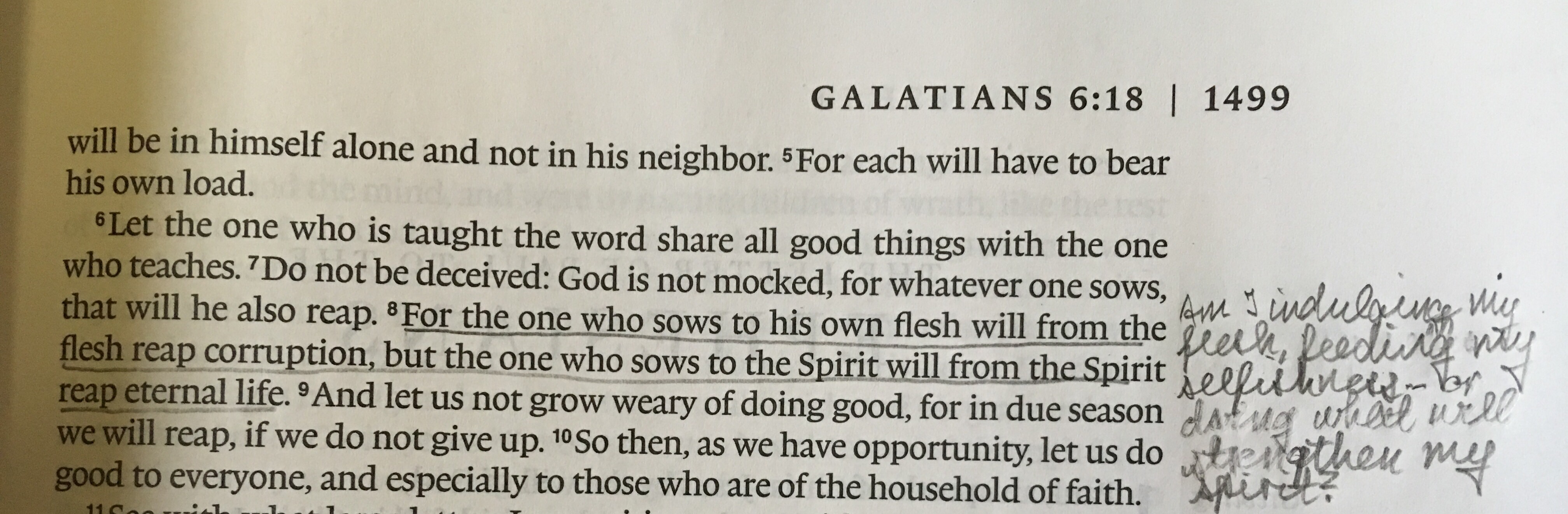
My Lectionary reading this morning included a passage from Galations, and one particular verse jumped out at me.

For the one who sows to his own flesh will from his own flesh reap corruption, but the one who sows to the Spirit will from the Spirit will from the Spirit reap eternal life.

I couldn’t help asking myself: am I indulging my flesh, feeding and catering to my selfish desires, nurturing those negative aspects of my nature — or am I doing all I can to strengthen my relationship with God and to make room for the Holy Spirit in my life?

What do I want to reap? Am I sowing the right seeds, planting and tending the right crop? I can’t scatter weed seeds, and spend my time tending them and watering them if what I really want to harvest is delicious fruit.

When I engage in selfishness, why am I surprised that I keep growing more selfish, more self-indulgent, and more full of an attitude of entitlement, rather than less?

My thoughts drifted to a sermon at a camp I attended in my teens, when the pastor described our internal battle, spirit versus flesh, as a struggle between a good dog and a bad dog. Which one would be stronger? He answered by saying, “It’s the one you keep feeding.”

Be careful what you feed.

I need that reminder today.

When husbands hate their wives

“The problem is…my brother-in-law didn’t [come] out of nowhere and become a murderer. These people are cultivated, they’re raised by families, they’re raised by friends, they’re raised by churches, they’re raised by their educational institutions, and they are chronic bullies from a very young age. I knew him, my friends knew him, my family knew him, and all along the signs were there, and they start small, and they turn big, and this is what it comes down to.” — Aleksandr Katane, brother of Lyuba Savenok who was murdered this past week by an abusive husband

To donate to Lyuba’s children, go here.

My podcast episode addressing this tragic situation can be found here.

Questions about hugs

Note: This is a follow-up to my previous post: Hugs: giving versus taking

Where can I find someone who will teach me how to hug in a giving way? Apparently my technique is all wrong.

Even though Nick Vujicic was born without limbs, people say he gives the best hugs.

UK0vo6O9

How is that possible? As one high schooler says, “Nick hugs with his heart.” Go and do likewise.

Then again, that might be your problem. (See the final question below.)

If I ask a friend for a hug, does that make me a hug-taker?

No. It probably just makes you a hug-receiver. With good friends, sometimes we may need a shoulder to cry on and other times we may be the one offering that shoulder. But if we are always, or even just usually, the needy one — without ever giving in turn — that’s not healthy.

There is another aspect to this as well. Even the neediest of hug-receivers may end up giving far more than they realize. I’m sure I’m not the only one who has found myself blessed and comforted by the very person I’m trying to comfort. If nothing else, you can receive the hug with gratitude, and your hug in return can express that.

Once again, it’s a heart issue and the difference between giving and taking can seem subtle. Consider asking the Holy Spirit to reveal to you the hidden places and motives of your heart — that’s usually far better than endless introspection. If you purpose to become the sort of person who gives graciously to others, you probably will. At least that’s my hope for myself!

Can’t I just hug without all this analysis and soul-searching? 

Of course. Hug away. Just make sure your hugs are welcome and not an intrusion or imposition. Try to think of the other person when you hug, and don’t be self-centered or use their body for personal gratification.

What if I’m the “high desire for non-sexual physical affection” spouse in a marriage with a husband who: a) only “hugs” me during sex; b) refuses to give or receive hugs except as foreplay; or c) is a hug-taker on the level of Creepy Hugger Guy?

First, a disclaimer lest the “Not All Guys!” police manage to catch wind of this post and denounce me as a female chauvinist pig: I know that there are probably husbands with a higher desire for hugs and non-sexual physical touch than their wives. However, what I’ve heard/read tends to confirm the stereotype. Before you say, “Well, that’s because you’re a woman and so guys don’t tell you these things”, let me offer this: back in my single days, I worked with a lot of married men. Some asked me for “the female perspective” on their marriage issues. Others trotted out the “my wife doesn’t understand me” line. So I heard plenty from husbands who thought their wives were unreasonable for wanting physical affection outside of sex, but not a word from any husband longing to give or receive more hugs. (By the way: I also learned the best way to shut down a guy claiming “my wife doesn’t understand me” is to say excitedly, “Your wife sounds just like me!” Only once did I have to ramp it up a notch and say I’d love to meet her.)

After that long disclaimer, back to the question. Maybe you’ve tried everything you can think of, even marriage counseling, and your husband, an otherwise fairly good guy, can’t or won’t change. Maybe physical touch isn’t his love language. Maybe, when he was growing up, his parents taught him that hugs were wrong and bad. Maybe he was abused. Maybe he’s simply not wired for intimacy. Maybe he has other reasons for not appreciating hugs. Maybe he thinks there is nothing wrong with being Creepy Hugger Husband and you can’t convince him that selfish or forced hugs and gropings aren’t working for you. Maybe he actually hates hugs unless sex is involved. Maybe he just doesn’t have very much to give. The bottom line is that some guys will never “get it”, and will never change, even if they wish they could.

You can’t change anyone but yourself. Sad and frustrating, but true. Once you face reality, you have two choices:

  1. Dump the dude and find a guy who gives good hugs from the heart.
  2. Learn how to live with the dude you’ve got.

There’s a theory about the disparity in male versus female desire/need for physical affection. Some say it is God’s design; after all, we are the ones who breastfeed and nurture babies and children. However, that feature seems more like a bug if you don’t have babies to cuddle, and it does nothing to protect you from the hug-taker.

What to do? I’m not a marriage counselor by any stretch of the imagination, and probably not the best source of marriage advice, but this is my 2 cents worth, which might not be worth even that:

If you are married to a hug-taker, recognize that you might become increasingly reluctant to give him hugs, since you feel depleted already. Unfortunately, this may turn things into a vicious cycle. It’s hard to give, give, give when there is no mutuality, and when your gift is turned into another opportunity for someone to take from you. Unless you have experienced this dynamic for any length of time, what I’ve written here may sound whiny and overly sensitive. What’s the big deal? It’s only a hug! But if you are a high-desire-for-real-hugs spouse married to a hug-taker, you know exactly how difficult the struggle can be. I have no idea what to tell you, other than perhaps you might consider doing some boundary work to protect your heart.

Recognize that your husband will never meet all your needs. No one can. Find people who will give and receive good hugs. Years ago, I met an older woman who was on a personal crusade to make sure the people in her life got three hugs a day. She even had cute little cards printed up. I loved it! I could count on at least two good hugs every time I saw her. Cultivate a hugging culture among your friends and in your social group. It can really fill that void, and meet your need for physical touch. 

Cuddle babies. Pet cute little puppies. But don’t stop there. Hand out hugs to teenagers. Hug lonely widows. In other words, give hugs to those who will appreciate them. You never know the difference you might make in the lives of people who sometimes go days, weeks, even months, without a single giving hug. Meet your need for hugs by meeting the same need in others. (For the sake of your marriage, it’s wisest to limit or avoid hugs with warm, attractive, emotionally available men.)

What if my wife claims I’m a hug-taker? Or what if I am the low-desire-for-hugs spouse? Or what if even the briefest hug fills me with an uncontrollable desire to have sex immediately, so I avoid any except as foreplay? Or what if I think hugs are wrong or stupid? Or what if I happen to like grabbing and groping my wife and think she needs to get over herself? Or what if I just don’t feel like hugging my wife unless there is something in it for me, like sex or at least getting to feel her up?

I don’t know. Maybe you should ask your wife and be willing to listen, really listen, without defensiveness. Then again, she may be way past the talking stage on this one, especially if lack of physical affection has been an ongoing issue in your marriage. You might try reading articles addressing low sexual desire in marriage and adapting the advice for hugs rather than sex (e.g., how to be an eager and willing hug partner even if you are never in the mood to hug). Personal therapy might help you figure yourself out. At the very least, try getting lots of prayer…for you and your wife.