Oh, that John Piper…

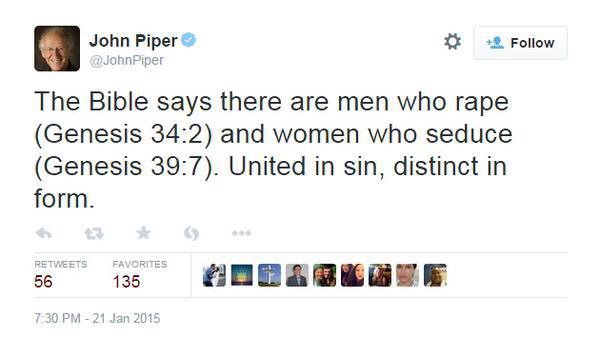
Sorry if you are a fan of his, but I have to take issue with something he recently tweeted:
2015/01/img_1162-0.jpg

A friend on Facebook alerted me to it, and linked to the following discussion of the tweet. I felt compelled to weigh in with two comments:

The topic of rape, in my opinion, does not lend itself well to sound bites and tweets. I have no idea if this tweet of John Piper had any sort of context or if it just appeared willy-nilly out of thin air — but that is the very problem of Twitter in general. John Piper spends far more time there than I do, and one would think a pastor/teacher of his reputation would know better than that. Well, I keep thinking that and getting disappointed, and maybe someday I’ll wake up, smell the coffee, and simply say, whether it’s him or others of his ilk, “That wasn’t surprising—he often says things like that. That’s just the way he is.”

In the meantime, since I am not fully conversant with Piper-speak, only tending to run across him when he’s spread some other doozy all over the Internet, I am left trying to stay charitable while puzzling out his meaning. It seems to me as if he is saying, with the words “united in sin” and “two distinct forms”, that rape is the male version and seduction the female version of the same sin. Perhaps he refuses to believe that women can rape since there is no such thing recorded in Scripture. But the Bible does describe men seducing women AND it makes a clear distinction between rape and seduction.

I am tempted to say something disparaging about celebrity preachers and their lack of scholarship. (I’m a preacher’s kid whose father set the bar very high in that regard, and it has taken me years to stop getting dismayed and annoyed that few people take Scripture as seriously as he does.) But instead, I think I’ll make this observation: when it comes to the topic of rape, most men simply don’t get it.

The blog author had used a definition of the word “seduce” that referred to coffee, which inspired me to add the following:

An addendum: Coffee is extremely seductive to me. When I am at my weakest, it sometimes seeks me out, like a smooth-talking cad, luring me in sensuously, promising me unspeakable pleasures and delight. Were coffee-drinking a sin, I could try to avoid its siren calls and delicious scent. If forced to be around it, I could pray for strength to avoid its enticements. I could apply the Biblical admonitions regarding how to resist temptation. It would be silly for me to frequent coffee houses and surround myself with cups of coffee.

The Bible contains advice on how to avoid falling for seducers. That’s because, no matter how overwhelming seduction might feel, we always make a choice to allow ourselves to be seduced. We don’t say no. Instead, we say yes. The Bible does not tell us how to avoid falling for rapists. There is a definite distinction.

I drink coffee willingly. Yes, I was enticed, but I am not a victim of coffee. Coffee has never forced itself on me against my will.

For a seduction to succeed, it requires two willing participants, both of whom have sinned. Rape, by definition, has only one willing participant (unless there is more than one rapist) and he is the only one who has sinned.

Very different sins.

If John Piper is a man of integrity with a high view of Scripture, we can expect, very soon, a profound apology and correction.

Call me cynical, but I’m not holding my breath. John Piper has deleted his tweet, although as of yet without explanation, so perhaps I should try to be satisfied with that.

A valuable article about childhood sexual abuse

How do sexual abusers gain the trust of their young victims and why do parents “let” them? How do they get by with it? Why don’t the child victims say anything? How can a mother insist she had no idea what was going on? These are questions that trouble people whenever the subject of childhood sexual abuse comes up.

I found an article online that offers a concise explanation of the “grooming” process. It is all valuable information, but I wanted to highlight this:

Mother blaming tactics

The myths around child sexual abuse often describe the reasons the offender sexually abused the child as being the mother’s fault. Some of these reasons could be that the mother was sick, worked long hours, or was frightened of the perpetrator. As a mother, you are not to blame for the sexual abuse. The sexual abuse of children is just one part of a system of trickery and abuse created to maintain secrecy, isolation and the offender’s absolute power over the child and all others in the child’s life. The offender sets up a web-like structure of traps, lies and distortions to isolate the victim and recreate the child as problematic in the eyes of siblings, the mother, friends, family and neighbours. In particular, offenders admit that their prime target is to destroy the child’s relationship of trust with the mother (Morris, 2003).

The relationship problems between mother and child that are commonly seen after the abuse is disclosed are more likely to be the result of a campaign of disinformation orchestrated by the offender. The offender’s actions create a context in which the mother and child are blind to his role in creating the difficulties in their relationship (Laing and Kamsler, 1990). In fact, one of the most common tactics by the offender is creating a division between the mother and child. The mother blaming shifts the focus from the offender to the mother, in search for someone to blame.

Research shows that the vast majority of mothers do not know that sexual abuse was occurring, and this is part of the offender’s campaign to keep the abuse secret. Offenders work hard to be seen as the idea father, uncle, grandfather, brother or a trusted family friend who is wonderful with children.

Read more here: Sex offender tactics and grooming

Redeeming the day

Yesterday, I ended my post with these words:

There was a time when I insisted to my therapist that my rape was so terrible, so dark and ugly, that there was nothing about it that God could possibly redeem. He proved me wrong…but that’s best left for future posts.

Almost immediately, the following came to mind. It’s something I wrote in 2009, after I’d been in therapy a few months. I’ve only done a few minor tweaks for readability, leaving the rest alone. It’s kinda raw. But it’s the raw and broken things that need redeeming, not the clean and pretty ones.

*****

During my therapy session today, Donny asked about the anniversary of the rape, and I told him I knew it was in August, but didn’t know the date. For some reason, after I got home, this started really bothering me. I went online to find an August 1981 calendar, and I started plugging different events into different days and finally, by process of elimination, I figured out that August 23 had to be the date.

And then I sat there, thinking, “Damn. I figured it out. But I don’t quite know what to think about it, or how to feel.” Then I realized that I was still being raped on August 24…the day that later became my wedding date. I regretted my figuring out the date, because I felt as if my wedding anniversary was now forever ruined for me. My imagination went into overdrive. I became convinced that, instead of celebrating our upcoming 25th anniversary, I’d be hiding in bed, having flashbacks, reliving that horrible day and the next day in awful, nightmarish detail.

So I posted to my online support group and Matt responded, “Well, think of this: for many years you did not know it was an anniversary. Which proves the date is not forever ruined, because you have had many August 23rd’s since your rape. And that endows you with a whole lot of post-rape August 23rd memories to recall, which are clean of any such traumatic triggers.”

That made sense.

I decided to quite whining to God, “How could you let me pick August 24 as my wedding date? And why didn’t the church let us have our first choice? Why? Why? Why?”

Then I thought, “What a coincidence…what are the chances that I would get married on that day?” But then it dawned on me — how cool, how redemptive, how absolutely victorious is it that, on the 3rd anniversary of my rape, I was having a rehearsal dinner with most of my favorite people in the world? The ugliness of the rape was the furthest thing from my mind that night. Three years after Lou and Carl finally stopped raping me, I was asleep in bed, dreaming happy dreams of marriage. Three years after that horrible shower, I was getting ready for my wedding day. Three years after sticking a gun in my mouth, feeling broken and ruined and filthy, I was walking down the aisle in a beautiful white dress that had been lovingly sewn for me. I remember that, during the wedding, I had kept thinking, “God is good”. I felt like I was basking in His love. And I actually felt beautiful.

God is good. I had no idea how good. He really did give me beauty for ashes, and the oil of joy for mourning. And He couldn’t have told me that in a more obvious way.

This August 24th will be my 25th wedding anniversary. It will also be the 28th anniversary of when they stopped raping me…the 28th anniversary of the day that I cleaned myself up and went to my first day at a new job, trying to pretend nothing had happened, the 28th anniversary of the day that I didn’t pull the trigger, the 28th anniversary of the day that I took my first steps towards being a survivor.

The “coincidence” of those dates, of forgetting the date of my rape until figuring it out all these years later — it all seems to me like a beautiful, redemptive story that God has made out of the ugliest days of my life. I feel as if He’s just given me the best 25th wedding anniversary I could think of getting.

*****

One of the things we, as survivors, often tell ourselves and each other is that the process of healing and recovery is not a smooth and constant one. There are setbacks along the way. That is the nature of healing in general, but I think that there can also be something else going on when it comes to recovery from sexual trauma. Based on what I have read, and my discussions with people experienced in the field of psychological trauma, I have come to believe that sexual trauma is unique in the damage it does to the human soul. Because of this, I also believe that the process of recovery is a sort of spiritual turf war being waged over one’s soul.

In retrospect, this seems obvious to me. 2009 was one of the most difficult years of my life. A tragedy brought me into therapy. At the same time, my husband almost died. Our entire family walked through some very deep waters. I experienced anguishing dark nights of the soul. All of that almost destroyed me.

In the midst of all that, God brought healing and moments of redemption. I wish I had trusted Him more and failed Him less. But despite my stumbling about, the fighting and wrestling I mentioned in my last post, and moments of absolute rebellion, He was faithful. He never gave up on me, his all-too-prone-to-wander prodigal daughter. No matter what, He always loves me back home again.

Why didn’t God stop them?

I was overwhelmed with the love of God. It came completely out of the blue, with no explanation, no rhyme nor reason, just the awareness and certainty of God’s love filling me on that summer evening back in 1981 as never before. What I felt was not an impersonal love, or a love for all mankind: He loved me — me — after everything I had done, and everything I hadn’t done…despite my every sin and failing…He loved ME.

This amazing sense of His love overwhelmed me in a parking lot of all places. I leaned against my friend’s orange VW squareback, looked at her across the roof of her car, and tried to articulate this incredible epiphany I was having. And then we returned from our errand to have dinner at my neighbor’s apartment.

Only the dinner was a ruse.

After pre-dinner cocktails, my friend became suddenly and mysteriously so ill and light-headed that she went to my apartment to rest. I was urged to stay because, after all, the Italian meal had been fixed in my honor. My host seemed to think it tragic that someone who had been to Italy had never even eaten pasta fagiole, and he had supposedly been slaving over a hot stove for hours on my behalf.

So I stayed.

Later, when I asked them to let me leave, when I tried to convince them to let me go, when I begged and pleaded, they refused. Eventually I wanted to die. The next afternoon, I came as close to killing myself as I think it is possible to do and remain physically unscathed.

Almost 28 years later, I sat in a therapist’s office, finally telling the entire story of my rape for the first time, instead of the highly abbreviated one sentence version, or scattered bits and pieces. Before then, I had only shared on a “need to know” basis to very few people.

One of the things I told my therapist was that it was as if God ceased to exist during that whole nightmarish, seemingly endless ordeal. One moment I was being love-bombed by Him…the next I was utterly abandoned.

That’s what immediately came to mind when I saw this on Facebook this morning:

IMG_0072.JPG

Yes, I was 23 years old when I was raped, but when my daughter was that age, do you think I would have walked away and left her at the mercy of a serial rapist and his accomplice/trainee? Was I more merciful than God? More moral?

There is no easy way to deal with these questions. Flinging platitudes and Bible verses at my pain did nothing to ease it. I had many dark nights of the soul, some so dark they almost consumed and destroyed me. I wrestled with God, to the point that I thought Jacob in the Bible had nothing on me.

Those who are satisfied only with an intellectual approach to God, based on chapter and verse of the Bible, won’t find much, if anything, of value in what I’m about to write…well, except perhaps for the first part. But I don’t believe God has chosen to confine Himself to the pages of His book. He is far too mysterious and wild and great and marvelous for that…and far too personal and immediate and, dare I say it, loving.

Here is how I came to make peace with the questions that plagued me…

1. Donny looked eager to tell me something at the beginning of one therapy session. “I almost called you,” he said, “but I thought it would be better to tell you in person.” During his devotions, he was reading systematically through the Bible, and he encountered a verse he had never noticed before:

“Woe to him who gives drink to his neighbors, pouring it from the wineskin till they are drunk, so that he can gaze on their naked bodies!” Habakkuk 2:15 NIV

Amazingly enough, there was no accompanying verse saying, “Woe to naive and overly trusting stupid idiots who don’t have sense enough to refuse drinks from their sleazy neighbors, who shouldn’t even be drinking with men in the first place, and who sin by drinking too much — you get what you deserve.” Apparently that was my victim-blaming opinion, but not God’s, so I was left to ponder the question my therapist posed: if God hated it when a neighbor got someone drunk In order to look at their naked body, how much more must He hate what my rapists did?

But if that was true, why did God abandon me?

2. I don’t have chapter and verse for this next one. All I can say is that, after much arguing and wrestling with God, there came a time when I just knew that He was there that night. Even though it felt to me, during that terrible night, as if He had ceased to exist, He was there all along.

That was hugely comforting and an amazing breakthrough for me, but it left unanswered the question: why didn’t He stop my rapists?

3. Eventually I came to realize that God places a high value on our free will. (Yeah, I know — Calvinists, you might as well shoot me now.) He didn’t stop Adam and Eve from sinning — and their sin opened the door to all the evil, suffering, and death we must now endure. I don’t pretend to understand this. I don’t pretend to like it. But a God who would overrule free will to stop all child rape would have to do the same for all rape…and all abuse…and all violence…and all betrayal…and all selfish use of another person…and all unloving acts…and where would that stop until we were rendered robots, without free will, forced to love God and all people?

4. I have had to make peace — as much as one can make peace with such tragedy — with the terrible fact that we live in a fallen world, one filled with sin and suffering and death. Part of making peace with that is my belief that this world is not all there is. I cling to a future hope, when all will eventually be made right.

5. I have come to believe in redemption. One day, all will be redeemed. In the meantime, God keeps showing me glimpses of redemption. There was a time when I insisted to my therapist that my rape was so terrible, so dark and ugly, that there was nothing about it that God could possibly redeem. He proved me wrong…but that’s best left for future posts.

More hidden secrets

Note: when I first tried to publish this post, half of it disappeared and I had to rewrite it. So if you read the first, abbreviated version, you may want to read it again, so it makes more sense.

As I mentioned in my “Journaling Confessions” post, I’ve been adopting a somewhat different approach — at least for me — to my practice of hopefully therapeutic journaling. I also mentioned the prompt, “What is my hidden secret?” and posted my first response to that.

My second was not quite so heavy or serious, but it was the first thing that I thought of when I sat down with my journal:

image

Today was my weekly therapy session, and I showed Donny both journal entries, feeling rather childish about them, especially the second one (which he commented on as if interpreting a child’s drawing). We spend more time discussing the first one, and discussing why/how I hide, and how this played out in particular this past weekend. (See “A Rough Day”.)

After the session, I started reading a book I recently got, Drawing from the Heart by Barbara Ganim. Inspired by what she wrote about creating images to express emotions, I decided to answer the “What is my hidden secret?” question again. I had been sitting at the park, trying to relax, doodling, and eating a brunch that I’d packed, and trying to ignore an unsettling feeling that had been growing in intensity.

What a great opportunity to put what I’ve been reading into practice! But then I quickly remembered that Drawing from the Heart emphasizes feeling, rather than thinking, so I stopped being analytical, got in touch with what I was feeling, and used that emotion and what felt like random impulse to choose chalk pastels as my medium, as well as to choose mostly black and a few other dark colors. This is the messy scribble I produced.

image


After I was finished, I wrote this.

image


In case, you can’t decipher my scrawls, it says:

I AM AFRAID.

OK, that’s hardly a hidden secret — pretty much everyone knows I’m a big huge chicken about almost everything.

This is how the worst of my fear feels. It’s all dark and cold and confusing and jumbled up. I can’t see anything, can’t make sense of anything, can’t find my way. Even the edges of the fear are like a dark fog. There are glimpses of color, even light, but at the very center, it’s pitch black — and it’s as if the darkness want to pull me in.

I just realized how much my fear and depression have in common.

This whole process still strikes me as odd. Drawing from the Heart makes the rather bold claim that the sort of scribbling I did can actually help someone heal from trauma. Obviously I was intrigued enough to buy the book, and to try to “draw” an emotion. But I was also skeptical. The funny thing is that, despite thinking the whole idea was a bit goofy, I couldn’t help notice that my sense of fear drifted away, as if by capturing its darkness on the piece of paper, I’d made it powerless to torment me. It seemed so insignificant, a messy scribble on a picnic table, out of place on such a beautiful and sunny day.

The other thing that surprised me is the realization of how similar my worst bouts of fear and my worst bouts of depression are. I think I would “draw” both pretty much the same way. When I was finished, that was my first thought: Wow, this looks just like depression!

Some time in the future I want to draw what it’s like to emerge from the darkness of fear and/or depression, but now I’m curious enough about Drawing from the Heart to want to try the seven week program. At any rate, I’m planning to do “Step One” tomorrow morning.