Allowing others to define us | Survivor Saturday

Recently I was listening to a podcast that discussed, among other things, the difference between guilt and shame. It gave the example:

  • Guilt says, “What I did was bad.”
  • Shame says, “Who I am is bad.”

As I listened, I was contemplating the place in my healing journey when I began realizing that I am not my actions. I may fail at something, but that does not mean my identity is “Failure”.

Much of my healing has involved dismantling lies and replacing them with truth. Sometimes those lies were told to me by others, but sometimes they were things I told myself. As I was reflecting over this, I was reminded of some of my previous blog posts, especially one titled We are not fragile or weak. I ended that post with the following:

We can’t help the blindness of others. But it is important that we open our eyes to who we truly are. We are survivors. We are the ones who cling to hope. We are the ones who bend, but never truly break. We are the ones who put back together the pieces of our lives that are broken, and emerge even better than before. We are not fragile, or we could not endure. We are not weak, or we could not do the hard work of healing. We are survivors. We are overcomers. We are strong.

Looking back over my healing journey, it’s obvious that I didn’t act like a strong, brave, victorious, conquering Super-Survivor every step of the way. Sometimes I felt like I kept getting knocked down, over and over again, and could barely pull myself up to stand one more time. I felt weak. Sometimes I felt like the most dismally frail and weak failure of all time. I would drag myself up the stairs to my therapist’s office and whine, “I can’t handle this. It’s too much for me.”

He would point out that I was, in fact, “handling this”. I had managed to climb the stairs once again, had managed to sit myself down on his couch yet another time, had managed to continue to bring to light the most terrible of my terrible secrets…and I did this week after week after week. As we were winding things down, and I was getting ready to “graduate” from therapy, Donny let me know that he had asked me the most difficult questions that he could, and that I had bravely faced every single one. We left no stone unturned.

Healing from trauma is messy. Sometimes it’s kind of like being stuck in a time warp. We may find ourselves feeling, acting, and being like our much younger selves. It would be funny if it wasn’t so disconcerting. Other times, it’s not even remotely funny, but simply raw and ugly. None of that looks particularly admirable to those who don’t understand the healing process. So, when they attempt to label and define us — even if they don’t mean to be insulting or belittling — they tend to accentuate the negative. Often, it’s all they see.

When people define and label us…even if they are using positive labels…they are attempting to speak into our identity, to tell us who we are. I am not sure anyone really has the right to do that. Even if they refuse to separate what they observe about us from who we are — our actions from our identity — we need to insist on doing so.

We are not our sins. We are not our failures. We are not our trauma. We are not our pasts. We are not what people did to us. We need to be very clear on this. We will not be freed from the burden of shame — the burden that Christ bore for us on the Cross — until we stop allowing the lies of shame to define us.

Guilt should lead us to conviction and repentance — and that’s a good thing, because it heals our relationship with God and makes intimacy with Him possible. Shame, however, leads to condemnation, and that never leads us to anything or anywhere that is good.

One of the most powerful parts of my healing took place this past year, when I received some intensive inner healing ministry. Probably the most beneficial aspect was examining the whole concept of identity, and getting rid of the false beliefs — and the resulting shame — that had plagued me for far, far too long. Only God, my Creator, has the authority to define me, to speak the definitive and enduring truth about my identity, and to tell me my worth. And I need to remember that the same applies to other people: it is not my place to label or define. It’s time we agreed with God about who we really are. Our truest identity is found in Him, and in Him alone.

Purity: it’s not just for virgins | Preaching to the choir

There are a lot of wrong messages coming out of “purity culture”, and I’ve written quite a bit about my concerns. One of the things that troubles me greatly is that the message of the gospel is too often being perverted by a false teaching of what purity is. The entire concept that we are born pure and can lose our purity should seem like jarringly false doctrine to evangelical Christians who believe in original sin and the power of redemption. It should, but all too often it doesn’t.

Another troubling aspect of “purity culture” is that it’s all about what one shouldn’t do, and doesn’t give a hope-filled message of what one should do. Furthermore, it’s a message that becomes meaningless the instant one marries…or at least the instant the marriage is consummated. The message is also skewed heavily towards young women, especially when the emphasis is on an intact hymen and the vehicle is father-daughter “purity balls”. Purity is seen as less important for young men.

This is not a Christian ethic, no matter what one tries to claim.

There’s an old-fashioned word I don’t hear very much, at least not in Protestant circles, but it’s an important one to use in discussions of sexual purity. That word is chastity. Sometimes chastity is thought to be synonymous with celibacy; however, the Catechism of the Roman Catholic Church teaches otherwise:

Chastity means the successful integration of sexuality within the person and thus the inner unity of man in his bodily and spiritual being. Sexuality, in which man’s belonging to the bodily and biological world is expressed, becomes personal and truly human when it is integrated into the relationship of one person to another, in the complete and lifelong mutual gift of a man and a woman.

either man governs his passions and finds peace, or he lets himself be dominated by them and becomes unhappy.  Man’s dignity therefore requires him to act out of conscious and free choice, as moved and drawn in a personal way from within, and not by blind impulses in himself or by mere external constraint. Man gains such dignity when, ridding himself of all slavery to the passions, he presses forward to his goal by freely choosing what is good and, by his diligence and skill, effectively secures for himself the means suited to this end.

This flies in the face of what is taught to too many girls within “purity culture”, where purity is equated with virginity marked by an intact hymen. This emphasis is so out of proportion to reality that I’ve known girls who agonized over whether using a tampon would cause them to “lose their virginity” and thus sacrifice their “purity”. I’ve read of a growing number of young brides who grieve the loss of their virginity on their honeymoons when they “give up their purity” to their husbands. What now? they wonder. The most valuable thing about them is gone forever. The precious gift has been given, sometimes to a husband who acts more entitled than appreciative, and now what do they have left?

Chastity, on the other hand, is a lifestyle. It is not something we are born with and must guard lest we lose it to the wrong person. It is, instead, a virtue we must cultivate with the help of the Holy Spirit, and it is just as important, if not more so, after the wedding night as before. Chastity is the healthy, God-honoring expression of our sexuality in a way appropriate to where we are in life, whether single or married. It is one way in which we present our bodies to Christ as a living sacrifice. It is one of the outworkings of sanctification.

By the grace of God, one can begin living a chaste life at any point. Even the most sordid past sins can be forgiven, and the Holy Spirit can empower the weakest of the weak to walk in repentance, in purity, and in holiness.

That’s the power of the gospel.

“And it is my prayer that your love may abound more and more, with knowledge and all discernment, so that you may approve what is excellent, and so be pure and blameless for the day of Christ, filled with the fruit of righteousness that comes through Jesus Christ, to the glory and praise of God.”  (Philippians‬ ‭1:9-11‬)

Purity: it’s not what you think, part 2 | Preaching to the choir

Why am I so opposed to equating virginity with purity? It’s not just because I grew up in the era of “technical virgins” who did “everything but”. It’s not because, as some legalists might accuse, I “hate purity”. In fact, it’s because I value purity so much that I don’t want to denigrate it, reduce it to something that it isn’t, or render it meaningless. (Read the rest of my previous post here.)

I’ve written about what purity isn’t, without saying enough about what it is. If we are discussing a Biblical perspective of purity, obviously we need to look at what the Bible has to say on the topic.

From BibleStudyTools.com:

In the New Testament, there is little emphasis on ritual purity. Rather, the focus is on moral purity or purification: chastity ( 2 Cor 11:2 ;  Titus 2:5 ); innocence in one’s attitude toward members of the church ( 2 Cor 7:11 ); and moral purity or uprightness ( Php 4:8 ;  1 Tim 5:22 ;  1 Peter 3:2 … ). Purity is associated with understanding, patience and kindness ( 2 Cor 6:6 ); speech, life, love, and faith ( 1 Tim 4:12 ); and reverence ( 1 Peter 3:2 ).

Purity is far more than virginity, and it’s not just about sex. I’ve noticed that those I know who walk out a lifestyle of radical purity are not trumpeting it forth loudly on the internet, nor do they draw undue attention to themselves in general, nor do they boast of their purity. It just becomes apparent as you get to know them, and it also becomes apparent that their purity is accompanied by other virtues…especially, it seems, humility.

IMG_3343

I have always loved the promise of 1 John 3:2-3 — that seeing our Savior as He really is will transform us radically. We shall be like Him! In the meantime, if that is our hope and our longing, we should be purifying ourselves, following the example of Christ.

“Take my yoke upon you, and learn from me, for I am gentle and lowly in heart, and you will find rest for your souls,” said Jesus in Matthew 11:29. We never find Christ boasting about the sins He didn’t commit. Instead, we find Him serving, being about His Father’s business, loving the unlovely, healing the sick, feeding the hungry, seeking and saving the lost, binding up the brokenhearted, setting the captives free, and sacrificing His very life for us. All along the way, He keeps reminding us that, when He lived among us in bodily form, He was showing us the Father.

We can’t become like Jesus all by ourselves. First, we need Christ to cleanse us from our sins, but then we need the power of the Holy Spirit to undertake the process of sanctification — that old-fashioned theological term that can be defined simply as being used for the purpose God intends. That means an ongoing, radical transformation…or at least it should, if we truly want to follow Jesus. More obedience, less rebellion and wandering. More love, less selfishness. More compassion, less indifference. More of His will, less of mine. More of Him, less of me. Gradually, we should become more and more holy — consecrated and set apart for service to God, more and more conforming to His will.

That’s purity. Anything less, and we’re just kidding ourselves.

I don’t know about you, but I’ve still got a long, long way to go.

Purity: it’s not what you think | Preaching to the choir

Purity is not what most purity advocates think it is.

But, before we get to that, it’s time we admitted that there is a lot of immodest behavior going on among those advocating modesty and decorum. For women claiming “freedom from boastfulness” and “behavior, manner, or appearance intended to avoid impropriety or indecency”, there is way too much “Look at me! I am so modest! And I’m hottest!”


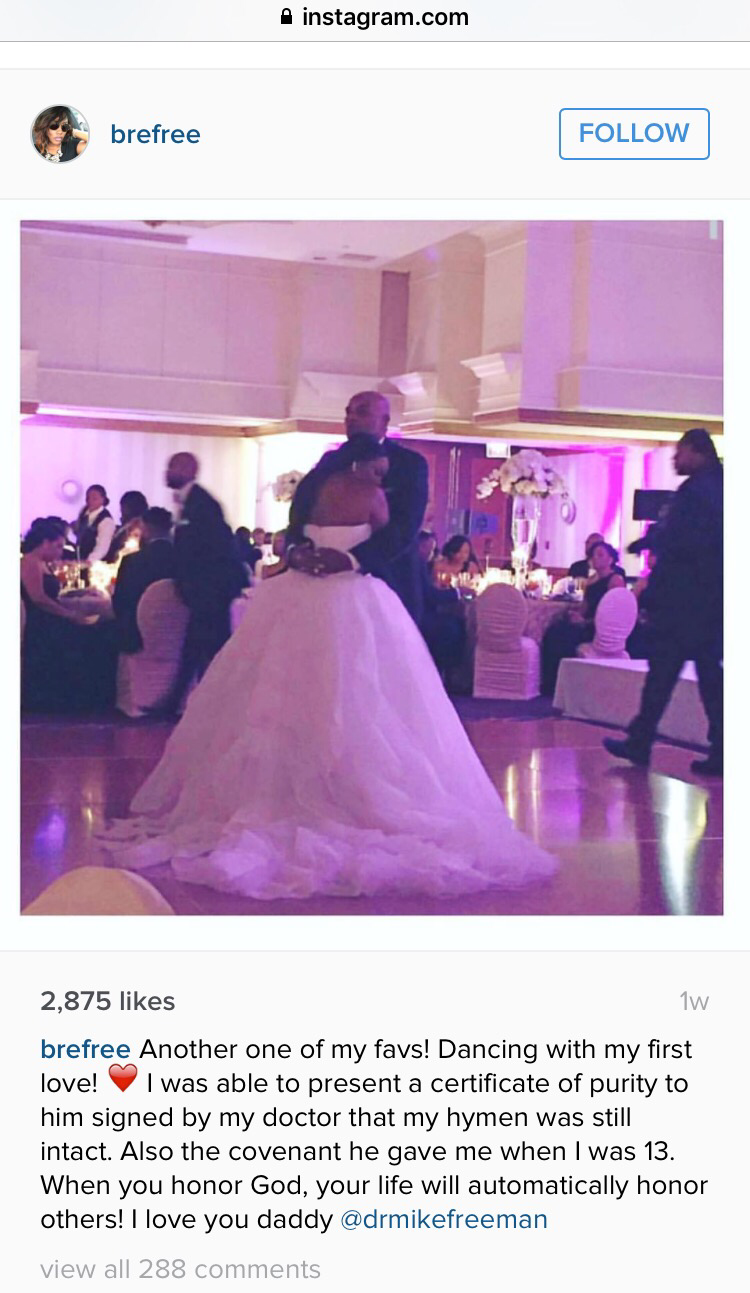
That brings us to immodesty under the guise of “purity”. A young woman who describes herself as a “preacher of purity” wants the entire world to know the results of her premarital gynecological exam, or at least the condition of the part of her sexual anatomy she wants to boast about.

This isn’t my first post about “purity culture” (see The problem with “purity culture” is not purity and “Purity Culture” doesn’t really understand purity) and I don’t want to belabor my previous points. However, there is one thing I would like to urge everyone, especially “preachers of purity”:

Stop using “purity” as a euphemism for “virginity” or “intact hymen”. STOP. The words do not mean the same thing.

To be graphic, I once met a girl who was safeguarding the intact state of her hymen but bragged to me that she had lost count of how many boys and men she had given blow jobs. She could have given her father a “certificate of virginity” on her wedding day, but there was more than one young men at her wedding who — from personal experience with her — would have snickered at the very idea that the “Blow Job Queen” ever possessed even a hint of purity.

Why am I so opposed to equating virginity with purity? It’s not just because I grew up in the era of “technical virgins” who did “everything but”. It’s not because, as some legalists might accuse, I “hate purity”. In fact, it’s because I value purity so much that I don’t want to denigrate it, reduce it to something that it isn’t, or render it meaningless.

Face it: there is no physical marker of purity. 

I might as well confess up front: I believe in original sin. To me, this means that we live in a fallen world and have a bent towards selfishness and sin. While most girl babies are born with hymens and all babies are born in a state of innocence, I do not believe we are born possessing “purity”, and that we lose this the instant — to put it bluntly — a penis breaks our hymen.

The sad truth is that we all sin and fall short of the glory of God. And the avid sex-obsessed reader of steamy romance novels cannot claim “purity” and moral superiority because of her virginity any more than the person who indulges in masturbation, porn, or plain old lust — even if these people have not as much as held hands with a member of the opposite sex, they have still sinned sexually.  After all, Jesus spoke against sins of the heart, and warned against being whitewashed sepluchres, all clean on the outside but filled with sin and death. Purity is a state of the mind, heart and soul far more than it is a state of the body.

And it’s not just about sex either, as we learn in ‭‭1 Corinthians‬ ‭6:9-11‬:

“Or do you not know that the unrighteous will not inherit the kingdom of God? Do not be deceived: neither the sexually immoral, nor idolaters, nor adulterers, nor men who practice homosexuality, nor thieves, nor the greedy, nor drunkards, nor revilers, nor swindlers will inherit the kingdom of God.”

Ever been greedy? Ever reviled — criticized in an abusive or angrily insulting manner — anyone? All of the boasting in the world over your intact hymen will not help you inherit the kingdom of God.

But here’s the good news:

“And such were some of you. But you were washed, you were sanctified, you were justified in the name of the Lord Jesus Christ and by the Spirit of our God.”

That is the gospel. It’s about Jesus far, far more than it is about us.

Contrast this with a post from the enthusiastic but sadly misguided young bride:

“Still enjoying my amazing honeymoon, but just saw this! Only the beginning! Thanks for all your support on social media over the last couple of days! We will continue to push & celebrate our decision. Thank you for helping us push a positive message! If one person has made a decision to wait until marriage or decide to stop & wait we have done our job! Let’s make Jesus famous! -Mrs. B #meetthebowmans#purity #livingmybestdays”

We don’t “make Jesus famous” by boasting about our intact hymens: “See? See?! I’ve got proof from a doctor!! Look at me! Look at me!!” We make Jesus famous by talking about what He has done, not by bragging about which particular sex acts we avoided before marriage. We make Jesus famous by not hogging the limelight. We make Jesus famous by pointing to Him instead of ourselves. We make Jesus famous by telling the truth about purity: it’s all because of Him, not us.

As the Apostle Paul wrote, “But far be it from me to boast except in the cross of our Lord Jesus Christ, by which the world has been crucified to me, and I to the world.” (Galatians‬ ‭6:14‬)

He also wrote, “For I decided to know nothing among you except Jesus Christ and him crucified. And I was with you in weakness and in fear and much trembling, and my speech and my message were not in plausible words of wisdom, but in demonstration of the Spirit and of power, so that your faith might not rest in the wisdom of men but in the power of God.” (‭‭1 Corinthians‬ ‭2:2-5‬)

None of us are pure. We all need washing. Some might have the sort of obvious sins and stains that make us look dirty to others. The road to true purity — being washed clean by Jesus and, increasingly, sanctified and set apart for Him — is, paradoxically, often far easier for us “blatant sinners” than for those with hidden or socially acceptable sins and stains. Far too many of the outwardly “good” might give lip service to God’s sustaining grace (“Let’s make Jesus famous by talking about how pure I have kept myself!”) but pride, judgmentalism, and self-sufficiency often blind them to the seriousness of their unholy and lost condition. Their faith rests too easily in themselves.

Thank God that His grace is sufficient for every sin and that His mercy extends even to those who do not fully comprehend how desperately they need Him. May their eyes be opened so that they will stop boasting in their flesh…whether they are boasting about their good deeds, the sins they didn’t commit, their circumcision, or their intact hymens. May even the most prideful and arrogant of boastful brides repent of her sin and learn to put her faith in God, and Him alone.

**********************

For a follow-up post, read here.

It’s so much fun to have enemies

…especially if you are on a crusade. In fact, then you need enemies. It doesn’t have to be a real crusade; it can be one of your own making, or one confined to your overwrought imagination. Or it can be a cause, a church, a group, a system of theology.

Imagine a crusade without enemies. What if you embarked on Your Great Cause, and no one opposed you? After awhile, in order to go on feeling brave and important, you would have to create enemies, because crusades require battles, and battles require foes. See that guy over there? He isn’t as enthusiastic about my cause — he may have even yawned once during one of my speeches — obviously he’s not for me wholeheartedly so he’s my enemy! And those people have their own cause instead of mine, so they must be enemies! And that woman complained when I spilled coffee on her child, so she has proven herself an enemy of The Cause! And he asked me a question that I didn’t like, so he’s an enemy as well!

Once you have enemies, you can vilify them, lampoon them, and mistreat them at will because this isn’t a crusade anymore, it’s WAR! And once war has been declared, the actual Cause no longer really matters — it’s all about amassing followers, attacking and defending, forming alliances, maintaining your position of power, and defeating the enemy.

The only problem is that, to outsiders who aren’t playing along with your war games, you start looking a little like a crackpot. Your dramatic cries about being under siege begin to sound delusional and paranoid. Eventually helpful observers try to talk you down: Maybe people are put off by your bizarre behavior. Perhaps you should stop running around waving your sword everywhere. People have a point; you do say some wacky and offensive things. You really need to be more careful with hot coffee around children, and you need to apologize to the people you’ve burnt. But you are unwilling to admit that they are right, or that not everyone who points out your error is a mortal enemy. If you did so, you might have to admit that the entire war that has consumed your life is a false one of your creation.

Even worse, you might have to admit the deep, dark secret you don’t even want to admit to yourself. Behind all your bluster and posturing on the pretend battlefield is this terrible, gripping fear, the question you dare not ask: without your war, who would you be? perhaps just a nobody, like everyone else?

Ephesians 6:12 tells us:

For we do not wrestle against flesh and blood, but against the rulers, against the authorities, against the cosmic powers over this present darkness, against the spiritual forces of evil in the heavenly places.

These people you think are your enemies? They are not your enemies. You are fighting the wrong battle, against the wrong enemies, in the wrong way.

But, you protest, the Bible says that there are “enemies of the Cross”! Face it — you are not the Cross; you are not the gospel. Quit pretending to be anything other than the fallen, sinful, saved by grace — just like the rest of us — sinner that you are. And, even if the enemies of the Cross sometimes happen to be your enemies as well, remember Jesus’ words in Luke 6:

“But I say to you who hear, Love your enemies, do good to those who hate you, bless those who curse you, pray for those who abuse you.”

That doesn’t mean get all snarky and verbally abusive with them, falsely accuse them, malign their motives, demean them, mock them, or dismiss their legitimate questions and concerns. It means love…do good…bless…pray. Love them as much as you love yourself.

Of course that’s impossible for most of us. That’s why we need Jesus…and why we need the Holy Spirit to empower us to do the impossible.

If the people we think are our enemies are people professing to be Christian, if we love Jesus, we will want what He prayed in His high priestly prayer: “that they may be one even as we are one”. How dare we wage civil wars within the Body of Christ? And if our supposed enemies do not believe in Jesus, we should be doing our best to love them into the Kingdom.

May I never forget that.

Let the wars and crusades cease. Let the love of Jesus reign instead.