The director and the actor, part 1

I don’t write allegories. Well, except for this one — inspired over two years ago by someone’s chance comment —  which practically wrote itself.

Like all allegories, it’s not perfect, so please don’t plumb it for depths of meaning or hold it up to theological scrutiny. Also, please don’t assume you can guess at the identities of the actor and the actress— they aren’t representations of anyone in particular. They could be an unhappily married couple…a pastor and his unruly flock…people trying to minister to the lost and broken..coworkers…family members…fellow Believers…or just about anyone. 

If you find anything in this allegory helpful or appropriate to your own situation, that’s great. I’m dusting this off and showing it the light of day only because I hope it might provide someone else with the same hope and comfort — and sorrowful conviction of sin — that it gave me back when my writing it caught me by surprise. 

More recently, I added a fourth part. Stay tuned.

The director sighed. “Are you serious?” he asked.

“Of course I’m serious!” the actor retorted. “I shouldn’t have to deal with this stuff. Things need to change!”

The director replied calmly and gently. “Look, I hope by now you know how much you mean to me, my friend. But it’s time you faced reality. You’re not the big star in a blockbuster movie; you’re just one of the many actors in Hours of Our Lives. Julia Roberts doesn’t even waste her talent on soap operas and, even if she did, our show couldn’t afford her. Plus, she’s way, way out of your league — she is very picky about her leading men.”

“OK, maybe not Julia Roberts, but someone else…anyone else! You cast the wrong person for this role! And the script — it’s all wrong!”

“Wait a minute. Didn’t you come to me, asking for my help and guidance? You could have chosen another director with a script you liked better. I warned you that working for me can be difficult and painful at times, even dangerous, and that I might ask you to make some big sacrifices. But you insisted you wanted me — and no one else — to direct you, that you trusted me, and that you would play any role I gave you. I tailor-made your part of the script for you, and I hand-picked the actress to play opposite you. Are you telling me you that I don’t know what I’m doing?”

“Of course not. You’re a great director, and you know how much our friendship means to me. But, you see, I have my own script. And, in my script, I have a much better wife. The one you came up with to play that role is terrible! She’s one big royal pain in the rear to work with. She argues with me all the time. It’s gotten so bad that I hate coming to rehearsals. She refuses to follow my script. She can barely act. She’s not at all pretty. How could you do this to me? It’s hard to even like her! Either you made some big mistake, or you’re trying to ruin my life. I know she is!”

The director sighed again, and spoke even more gently, “I can see that you’re upset. I know this is not an easy role that I’ve given you. But it’s nowhere near as bad as your description! I think you are making things more difficult than they need to be. Don’t you trust me?”

“Of course I do. How can you even ask that? It’s just that I have this really great script I’ve been working on for years, and I know it’s the right one for me — and I know this…this ‘actress’ you came up with is completely wrong for the role of my character’s wife.”

“I see.” The director sounded grieved. “So you think your script is better than mine?”

“Um, no. I just thought maybe we could work on the script together, you know…a lot of my ideas are based on your script, anyway. For example, there’s the part in your script that describes the wife as being ‘sensitive’. Well, my script has all these scenes showing exactly how a sensitive wife should treat her husband, and your script seems to be missing that.”

“But my script has scenes about how a loving husband is supposed to treat his wife, yet you refuse to play them.”

“That’s not true! I play them exactly as written! My character is extremely forgiving towards his awful shrew of a wife. Even though she is so terrible, he puts up with her.”

“I don’t think you’ve read my script carefully enough,” the director said, but his voice was so soft that the actor chose to ignore it. So then the director said, “You need to realize something. The actress you are so upset with is also my friend. You know how I give you the lines you need each day? Neither of you has read each other’s parts…and neither of you has read the entire script. You don’t know how it plays out.”

“Well, if you’re friends with her, you must know how awful she is and what a terrible job she’s doing with this role! I can’t believe that she is even consulting your script — surely you wouldn’t write such a horrible story!”

“Oh, she comes in here a lot — ”

“What? She’s probably complaining about me — she is always complaining — and I bet she argues with you a lot — she is such a contentious woman that I dread being around her!”

“Not at all. I love her company…even when she cries. Unfortunately, she does that a lot —”

“Trying to manipulate you with her tears, huh?” the actor didn’t bother hiding his contempt.

“No.” The director looked straight into the actor’s eyes and, although his voice stayed gentle, there was a firm edge to it. “I think you are forgetting what I just said. She is my friend. And I am the director, remember? That makes her a friend of the director. You don’t know her as well as I do. Just like you, she is one of my most precious friends. I was hoping you and she could be friends also, but instead, I have watched you snub her, deliberately rebuff her every offer of friendship, and even go so far as to publicly humiliate her.”

At this point, the actor got defensive and tried to make excuses, but the director cut him off. “You can pretend to yourself, but I see right through it.” He paused and then went on, “You know how you often tell me that you want to be just like me, that I’m your role model? Then why are you refusing to follow my example?” He held up his hand to silence the actor’s protests. “If you were like me,” he said in the saddest voice the actor had heard him use in a long time, “you would love her, because I love her. Besides, she is trying to be like me also — if you were truly my friend, you would love her for the ways she takes after me. And you would thank me for choosing her to play the role of your character’s wife.”

Love her? Thank him? What kind of crazy talk was that? The actor muttered after he left in a huff. Obviously the director didn’t understand. That terrible actress was nothing like the director! He grew angrier the more he thought about their conversation. “That’s some fine way for the director to treat me after all my years of devotion to him! I’ll play in his stupid show, because I’m a decent guy who keeps his word, but I’m only doing it out of a sense of duty. I’m not going to like it, and there is no way I will ever thank him for making me work with such a terrible actress!”

**********

Read Part 2.
Purity: it’s not just for virgins | Preaching to the choir

There are a lot of wrong messages coming out of “purity culture”, and I’ve written quite a bit about my concerns. One of the things that troubles me greatly is that the message of the gospel is too often being perverted by a false teaching of what purity is. The entire concept that we are born pure and can lose our purity should seem like jarringly false doctrine to evangelical Christians who believe in original sin and the power of redemption. It should, but all too often it doesn’t.

Another troubling aspect of “purity culture” is that it’s all about what one shouldn’t do, and doesn’t give a hope-filled message of what one should do. Furthermore, it’s a message that becomes meaningless the instant one marries…or at least the instant the marriage is consummated. The message is also skewed heavily towards young women, especially when the emphasis is on an intact hymen and the vehicle is father-daughter “purity balls”. Purity is seen as less important for young men.

This is not a Christian ethic, no matter what one tries to claim.

There’s an old-fashioned word I don’t hear very much, at least not in Protestant circles, but it’s an important one to use in discussions of sexual purity. That word is chastity. Sometimes chastity is thought to be synonymous with celibacy; however, the Catechism of the Roman Catholic Church teaches otherwise:

Chastity means the successful integration of sexuality within the person and thus the inner unity of man in his bodily and spiritual being. Sexuality, in which man’s belonging to the bodily and biological world is expressed, becomes personal and truly human when it is integrated into the relationship of one person to another, in the complete and lifelong mutual gift of a man and a woman.

either man governs his passions and finds peace, or he lets himself be dominated by them and becomes unhappy.  Man’s dignity therefore requires him to act out of conscious and free choice, as moved and drawn in a personal way from within, and not by blind impulses in himself or by mere external constraint. Man gains such dignity when, ridding himself of all slavery to the passions, he presses forward to his goal by freely choosing what is good and, by his diligence and skill, effectively secures for himself the means suited to this end.

This flies in the face of what is taught to too many girls within “purity culture”, where purity is equated with virginity marked by an intact hymen. This emphasis is so out of proportion to reality that I’ve known girls who agonized over whether using a tampon would cause them to “lose their virginity” and thus sacrifice their “purity”. I’ve read of a growing number of young brides who grieve the loss of their virginity on their honeymoons when they “give up their purity” to their husbands. What now? they wonder. The most valuable thing about them is gone forever. The precious gift has been given, sometimes to a husband who acts more entitled than appreciative, and now what do they have left?

Chastity, on the other hand, is a lifestyle. It is not something we are born with and must guard lest we lose it to the wrong person. It is, instead, a virtue we must cultivate with the help of the Holy Spirit, and it is just as important, if not more so, after the wedding night as before. Chastity is the healthy, God-honoring expression of our sexuality in a way appropriate to where we are in life, whether single or married. It is one way in which we present our bodies to Christ as a living sacrifice. It is one of the outworkings of sanctification.

By the grace of God, one can begin living a chaste life at any point. Even the most sordid past sins can be forgiven, and the Holy Spirit can empower the weakest of the weak to walk in repentance, in purity, and in holiness.

That’s the power of the gospel.

“And it is my prayer that your love may abound more and more, with knowledge and all discernment, so that you may approve what is excellent, and so be pure and blameless for the day of Christ, filled with the fruit of righteousness that comes through Jesus Christ, to the glory and praise of God.”  (Philippians‬ ‭1:9-11‬)

Purity: it’s not what you think | Preaching to the choir

Purity is not what most purity advocates think it is.

But, before we get to that, it’s time we admitted that there is a lot of immodest behavior going on among those advocating modesty and decorum. For women claiming “freedom from boastfulness” and “behavior, manner, or appearance intended to avoid impropriety or indecency”, there is way too much “Look at me! I am so modest! And I’m hottest!”


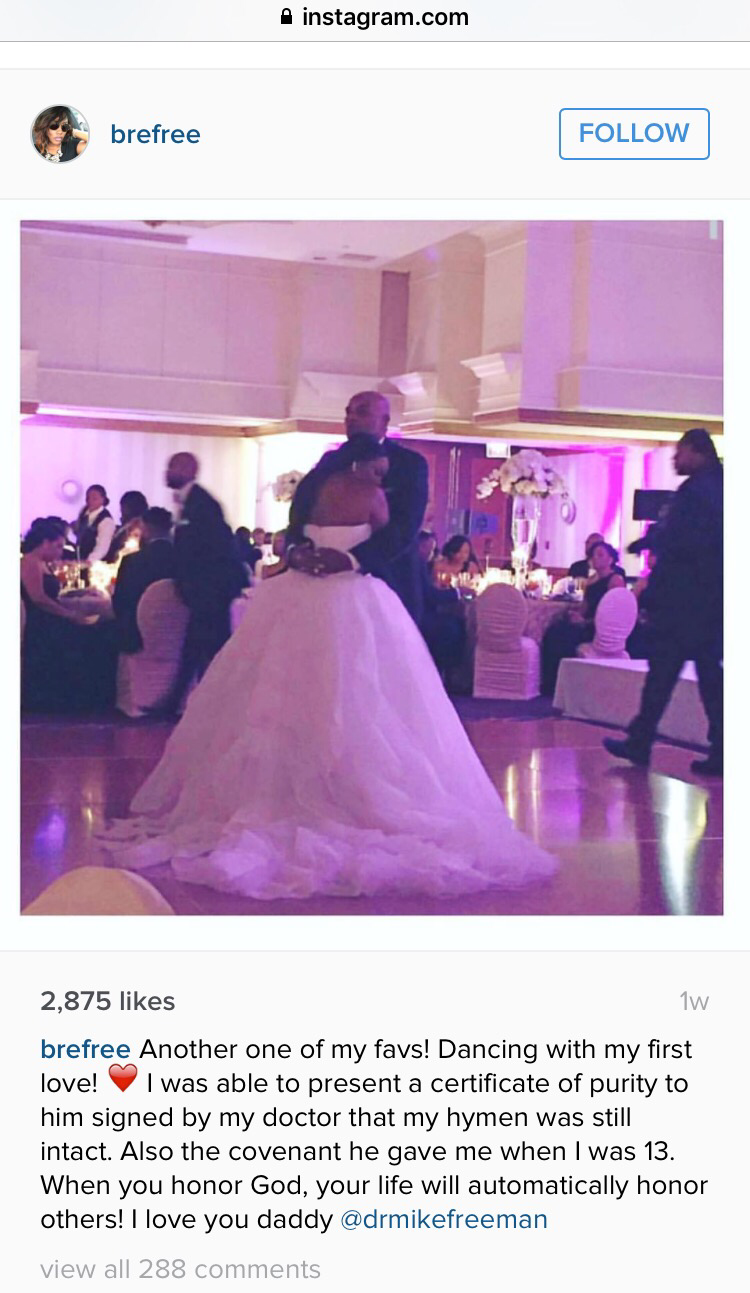
That brings us to immodesty under the guise of “purity”. A young woman who describes herself as a “preacher of purity” wants the entire world to know the results of her premarital gynecological exam, or at least the condition of the part of her sexual anatomy she wants to boast about.

This isn’t my first post about “purity culture” (see The problem with “purity culture” is not purity and “Purity Culture” doesn’t really understand purity) and I don’t want to belabor my previous points. However, there is one thing I would like to urge everyone, especially “preachers of purity”:

Stop using “purity” as a euphemism for “virginity” or “intact hymen”. STOP. The words do not mean the same thing.

To be graphic, I once met a girl who was safeguarding the intact state of her hymen but bragged to me that she had lost count of how many boys and men she had given blow jobs. She could have given her father a “certificate of virginity” on her wedding day, but there was more than one young men at her wedding who — from personal experience with her — would have snickered at the very idea that the “Blow Job Queen” ever possessed even a hint of purity.

Why am I so opposed to equating virginity with purity? It’s not just because I grew up in the era of “technical virgins” who did “everything but”. It’s not because, as some legalists might accuse, I “hate purity”. In fact, it’s because I value purity so much that I don’t want to denigrate it, reduce it to something that it isn’t, or render it meaningless.

Face it: there is no physical marker of purity. 

I might as well confess up front: I believe in original sin. To me, this means that we live in a fallen world and have a bent towards selfishness and sin. While most girl babies are born with hymens and all babies are born in a state of innocence, I do not believe we are born possessing “purity”, and that we lose this the instant — to put it bluntly — a penis breaks our hymen.

The sad truth is that we all sin and fall short of the glory of God. And the avid sex-obsessed reader of steamy romance novels cannot claim “purity” and moral superiority because of her virginity any more than the person who indulges in masturbation, porn, or plain old lust — even if these people have not as much as held hands with a member of the opposite sex, they have still sinned sexually.  After all, Jesus spoke against sins of the heart, and warned against being whitewashed sepluchres, all clean on the outside but filled with sin and death. Purity is a state of the mind, heart and soul far more than it is a state of the body.

And it’s not just about sex either, as we learn in ‭‭1 Corinthians‬ ‭6:9-11‬:

“Or do you not know that the unrighteous will not inherit the kingdom of God? Do not be deceived: neither the sexually immoral, nor idolaters, nor adulterers, nor men who practice homosexuality, nor thieves, nor the greedy, nor drunkards, nor revilers, nor swindlers will inherit the kingdom of God.”

Ever been greedy? Ever reviled — criticized in an abusive or angrily insulting manner — anyone? All of the boasting in the world over your intact hymen will not help you inherit the kingdom of God.

But here’s the good news:

“And such were some of you. But you were washed, you were sanctified, you were justified in the name of the Lord Jesus Christ and by the Spirit of our God.”

That is the gospel. It’s about Jesus far, far more than it is about us.

Contrast this with a post from the enthusiastic but sadly misguided young bride:

“Still enjoying my amazing honeymoon, but just saw this! Only the beginning! Thanks for all your support on social media over the last couple of days! We will continue to push & celebrate our decision. Thank you for helping us push a positive message! If one person has made a decision to wait until marriage or decide to stop & wait we have done our job! Let’s make Jesus famous! -Mrs. B #meetthebowmans#purity #livingmybestdays”

We don’t “make Jesus famous” by boasting about our intact hymens: “See? See?! I’ve got proof from a doctor!! Look at me! Look at me!!” We make Jesus famous by talking about what He has done, not by bragging about which particular sex acts we avoided before marriage. We make Jesus famous by not hogging the limelight. We make Jesus famous by pointing to Him instead of ourselves. We make Jesus famous by telling the truth about purity: it’s all because of Him, not us.

As the Apostle Paul wrote, “But far be it from me to boast except in the cross of our Lord Jesus Christ, by which the world has been crucified to me, and I to the world.” (Galatians‬ ‭6:14‬)

He also wrote, “For I decided to know nothing among you except Jesus Christ and him crucified. And I was with you in weakness and in fear and much trembling, and my speech and my message were not in plausible words of wisdom, but in demonstration of the Spirit and of power, so that your faith might not rest in the wisdom of men but in the power of God.” (‭‭1 Corinthians‬ ‭2:2-5‬)

None of us are pure. We all need washing. Some might have the sort of obvious sins and stains that make us look dirty to others. The road to true purity — being washed clean by Jesus and, increasingly, sanctified and set apart for Him — is, paradoxically, often far easier for us “blatant sinners” than for those with hidden or socially acceptable sins and stains. Far too many of the outwardly “good” might give lip service to God’s sustaining grace (“Let’s make Jesus famous by talking about how pure I have kept myself!”) but pride, judgmentalism, and self-sufficiency often blind them to the seriousness of their unholy and lost condition. Their faith rests too easily in themselves.

Thank God that His grace is sufficient for every sin and that His mercy extends even to those who do not fully comprehend how desperately they need Him. May their eyes be opened so that they will stop boasting in their flesh…whether they are boasting about their good deeds, the sins they didn’t commit, their circumcision, or their intact hymens. May even the most prideful and arrogant of boastful brides repent of her sin and learn to put her faith in God, and Him alone.

**********************

For a follow-up post, read here.

Why it’s hard to believe us

Spend any time around those of us who are sexual trauma survivors, and you will hear account after account of how people — even our own families and loved ones — disbelieved us and sometimes went so far as to take up the side of the predators, rapists, pedophiles, and abusers who perpetrated against us. It is such a common occurrence that, when I encounter the opposite, I am deeply moved. Once when I met parents who stood by their daughter even when others insisted she was just “crying rape”, I was so touched by their family’s story that I hugged them, thanked them profusely, and started crying!

Today I read something that was linked to in the comments on one of my previous posts. It is an open letter from a pastor, a humble admission of his serious error, that says, among other things: “Though I never doubted that Jamin was guilty, I trusted his account of the circumstances more readily and longer than I should have, and conversely I disbelieved the victim’s parents.” He describes the sex offender as, “deceptive and highly manipulative”.

It’s hard to believe us when our perpetrators and predators are accomplished manipulators. After all, unless our abuser was a complete stranger who jumped out at us from the bushes, he first somehow gained entry into our lives, and usually managed to deceive enough people to gain a position of trust. Those who prey on children need to be somewhat accomplished con artists in order to deceive not only the child, but everyone around the child.

We, on the other hand, usually are not skilled liars and manipulators. Furthermore, we are traumatized, and traumatized people don’t always behave in a way that others might find credible, reasonable, understandable, or even likable. We are trying to piece together horrible events, trying to make sense of them, trying to sort them out in our minds, trying to deal with the horror of it all, or perhaps trying to escape thinking about our nightmarish ordeal at all. That’s bad enough, but then there are everyone else’s reactions to what happened to us, and not all of those reactions are helpful or healing. In fact, all too often, the reactions of others only adds to our trauma.

Our abusers, on the other hand, are not traumatized. They seem calm and rational, with a well thought out and plausible-sounding answer to every question. If they are serial predators, they have honed their “act”, and know just what to say or do in order to manipulate, and play on the sympathies of others.

In the immediate aftermath of trauma, we don’t always “make sense” to other people. Our stories don’t always sound believable. Usually we can’t bring ourselves to say much, and what comes out may be a chaotic jumble. We may get things out of order, remember things differently a few days or weeks later, only let a few details out in dribs and drabs, and be afraid to talk about major aspects of what happened to us. We may try to protect our abuser, if he is a family member or loved one. We may feel intimidated into silence. We may be too upset to admit the most shameful aspects of our abuse.

Years after my rape, when I finally told as complete an account of it as I could to my therapist, I halfway expected him to say that it sounded too unbelievable, too weird, too unlikely. I expected questions like, “How bad could it have been if you went to work the next day?” or “What do you mean, you have no idea of the extent of your injuries?” or “How convenient that there are those gaps in your memory!” or “What on earth is that nonsense that you supposedly ‘went away’?” I expected him to poke holes in my story, to cross-examine me as if I were on the witness stand, and to tell me that mine was the fishiest-sounding rape story he had ever heard. I was shocked that he believed me, shocked that he never cast one suspicious look in my direction, shocked that he didn’t try to blame me in the slightest for anything that happened that night.

Then again, he was a therapist. My anguished telling of what had happened to me wasn’t the first, or tenth, or even hundredth sexual trauma account he’d ever heard, and he knew all too well what trauma does to us, even years later.

Pastors don’t know these things, nor do they have the experience and training of my therapist. Ordinary people don’t either. But, unfortunately, many are arrogant and assume they know things that they don’t. They sit judge and jury over survivors and their families and judge us less than credible, because we cannot make them understand. Sometimes they are even joined by other survivors — who have not walked far enough in their healing to have enough empathy and wisdom to do otherwise — who help rub the salt of skepticism and disbelief into our wounds.

We understand that our predators seem believable and trustworthy. After all, they had to dupe us and set us up before they could betray us. But you will probably never understand how deeply you wound us when you believe them over us.

Please believe us. Please.

And, if you’re reading this, and you have any reason to think that you may have added to a survivor’s trauma by your lack of support, please — in the name of all that is good and holy — humble yourself and apologize. Let your words be a healing balm. You may never know how desperately that survivor has longed to hear you ask forgiveness.

The open letter I wish Douglas Wilson had written

Pastors are not infallible. None of us are. Sometimes we want to believe so desperately that someone has repented and changed, that he or she is trustworthy, and that the past is in the past, that we throw caution to the wind…only to have our trust betrayed. “But they promised…!” 

Humility enables us to admit that we were duped, overly trusting, naive, mistaken, whatever. Pride blinds us and makes us prone to repeat our mistakes.

First some background: Doug Wilson’s Failure to Safeguard Children

And now the open letter that I wish Douglas Wilson had written, instead of the numerous blog entires he has been churning out of late:

In light of the recent court proceedings involving Steven Sitler, and the resultant coverage of those proceedings in the media, I believe that it is necessary for me to make a public statement taking full responsibility for my actions in this matter. Rather than get bogged down in details that are readily available elsewhere on the internet, I would like to confess the following.

I made several grave errors in judgment. As Mike Sloan and Beth Hart have stated, “Offenders are masters of deception and manipulation, often saying what people want to hear so that they attract attention and compassion toward themselves and away from their victims.” I was deceived. But it’s worse than that: my pride prevented me from listening to the warnings and advice of others with more knowledge and expertise.

Furthermore, I misapplied the Scriptures that state it is better to marry than burn, and that each man should have his own wife because of the temptation to sexual immorality. Obviously Steven Sitler is not dealing with garden-variety sexual temptation. His desire to abuse, molest, and harm children will not be fulfilled or healed by the love of a good woman, and it was naive of me to think so.

I believe in the power of the gospel to transform lives; however, it was both naive and prideful of me to think that I could judge whether or not Steven Sitler’s repentance was genuine. Anyone can appear godly and contrite in half a dozen meetings in his pastor’s office — especially when the pastor is, like me, unqualified and untrained in counseling sex offenders — and the fact that he was willing to read some books means little. Furthermore, if he was truly repentant, he would understand and accept that he can never have a close relationship with any child, and certainly cannot be in an authority position over one. Thus, a Biblical marriage — one that is open to life — would be out of the question for him.

If I had to do it over again, I would have advised the elder in my church to give up on his misguided matchmaking efforts. I would have advised against marriage for Steven Sitler, and quoted Matthew 18:6 to him at every opportunity. It would be far better for a serial pedophile to have a great millstone around his neck and be drowned in the depth of the sea than for him to have the opportunity to harm and damage any more children. If we would not allow him to babysit children in our church nursery, certainly we cannot encourage him to have children of his own. It was wrong of me to perform that marriage ceremony.

I wish to repent publicly of my pride, arrogance, and lack of compassion.

Furthermore, I wish to repent of erroneous statements I have made regarding the very nature of marriage itself. Years ago, I foolishly wrote, “A man penetrates, conquers, colonizes, plants.” What a mischaracterization of the beauty and tenderness God intends for the sexual relationship! What an offensive way to describe the act that God designed to be an expression and means of intimacy, unity, and fruitfulness! 

In addition, I maligned many good, decent, loving men by claiming, “Men dream of being rapists.” I should have stated that only ungodly, immoral, depraved men would dream of such a thing, and that men with these desires need to repent immediately — and women need to protect themselves from these men until they demonstrate lasting fruit of repentance. Counseling by someone far more qualified than I am would probably be in order as well.

I deeply regret that much harm that has been caused by my pride, foolishness, poor judgment, and grave error. I pray that those I have harmed and offended would find it in their hearts to forgive me. I am grief-stricken over how I have contributed to the sufferings of even just one innocent child. May God have mercy on us all.

Of course what Douglas Wilson has really written is nothing like this.