
The problem with “purity culture” is not purity

She was raised in an ultra-conservative Christian homeschooling family, with loving but legalistic parents. Or maybe they were more protective than legalistic; as an adult, she is still trying to puzzle that out. There is no doubt in her mind that they loved her and meant well.

The circles in which they traveled, especially as she approached her teens, emphasized — among other things — purity. Although her brothers got what came across to her as somewhat of a token, “Oh, by the way, boys and men need to stay pure also”, the real targets of the “purity message” were the girls. Whether or not her parents, pastors, youth leaders, and the authors of the books and articles she read intended to teach her the following, this is what she came to believe:

  • Purity is defined exclusively in sexual terms. Sexual deeds make you impure. Thoughts do too, but to a much lesser extent.
  • The single most important and valuable thing about a girl is her purity. It is the most precious gift she can give her husband, yet it is also owed him to the extent that she is robbing him should she squander her purity on anyone else.
  • Boys and men have many other things that are important and valuable about them, and many other things to offer their future wives. Their purity is of lesser value, does not define their worth, and is not the most important thing about them.
  • The most valuable thing about a girl or woman is her sexuality. It might be the only thing of value about her, unless she marries a man who also appreciates her homemaking skills. However, even the most amazing domestic talents and abilities will never make up for being sexually impure, broken, or lacking.
  • Men are far more valuable than women, because they are not judged and defined solely by their sexuality.
  • While it’s nice if your future husband does not have a sexual past, he does not owe you his purity. You have no right to be judgmental or unforgiving of anything he might have done. His past, if he has repented of it, should no longer matter.
  • A girl is not only responsible for guarding her own purity, but the purity of everyone who encounters her. She needs to scrutinize her actions and appearance at all times in order to make sure she is not causing anyone to stumble.
  • It is impossible for boys and men to maintain purity in their thought lives. In fact, there is no such thing. Males are wired in such a way as to be on the verge of sexually explicit thoughts and desires at all times, and thus the most seemingly innocent thing can set them off. For example, if a boy sees a girl with wet hair, he cannot help imagining her naked in a shower, begging him to have sex with her.
  • Men and boys are incapable of respecting a girl or woman that they want to have sex with. This would seem like a problem in marriage but, while it’s important for an unmarried woman to gain the respect of men, wives supposedly no longer need respect. Only husbands do.
  • Men and boys are incapable of respecting a girl or woman who has lost her purity. It’s kind of debatable whether the sex act in marriage causes a woman to lose her purity or not. After all, the fact that she “gives” her purity (as the greatest gift she could possibly give) to her husband implies that she no longer possesses it. Luckily she only needs love from her husband and not respect. Marriage apparently mysteriously transforms a woman that way.
  • Once a girl or woman loses her purity before marriage, she is ruined forever. She can repent and be forgiven by God, but her purity is gone, never to be regained. She has robbed and cheated her husband out of the only thing of real value about her.

The young woman I am writing about is not the only one to believe these things. Not by a long shot.

I would hope that readers would see this as a problematic message. Whether or not this is the intention of the proponents of “purity culture”, it is what many young women are learning in homes, churches, youth groups, books, articles, blog posts, homeschooling conferences, etc., often with heartbreaking and disastrous consequences. One need not search very hard on the internet to find tragic story after story. Some young women who were harmed by growing up with these pervasive messages are now speaking out quite strongly against not only “purity culture” itself, but the very idea of remaining sexually pure until marriage.

The problems with “purity culture” are legion, but I will address only three of them for now:

1. It sexualizes women and girls — even very young girls — and repeats our media-saturated culture’s false message that women’s value is measured by sexuality and little or nothing else.

I mentioned the creepy sexualization of little girls when I wrote about “Purity Balls” on my old blog. In many ways, “purity culture” robs little girls of their innocence by forcing them to view themselves as sexual beings when they should be running and playing and learning — free of concerns about their future wedding nights. We should be teaching them what it means to be a follower of Jesus now, as wonderful little girls, and how they are of infinitely more value to Him, and more beloved, than they could ever imagine.

We need to tell girls and women that their worth rests in far, far more than their sexuality. The most valuable, precious gift a woman can give her husband is herself, in all her fullness and complexity. Sexuality is a part of that, yes, but I must emphasize again that her worth is in her personhood — who she is in the totality of her being, her talents and abilities, her personality and character, her knowledge and wisdom, her life experiences, her accomplishments, her relationship with God, her morals and values, her thoughts and opinions, her hopes and dreams — all that and more makes her uniquely who she is — and that’s what she brings into marriage.

Her sexuality is not a commodity that she sells in exchange for a wedding ring, or that her father sells on her behalf. Marriage is neither prostitution nor domestic service. Or at least it shouldn’t be. Any teaching or belief that even hints that it might be, or that virginity is owed as part of the transaction, is ungodly. Any boy who does not truly understand what is most precious about any woman — far, far more precious than her virginity — is not ready to be a husband…or at least not a very good one.

2. “Purity culture” has no idea what purity really is. Purity is not some treasure that girls are born with and that they need to guard desperately and fearfully until the day that they give it to their husbands. No one need weep on her wedding night, as one distraught “purity culture” young woman did, over the loss of what once defined and gave her worth.

Purity is not an intact hymen. It is not virginity. It is not a lack of sexual experience. It is not even saving your first kiss for the wedding. Purity is not a “thing” that you can give away or that someone can steal from you.

More times than I care to count, I’ve been told heartbreaking accounts of young girls being sexually abused, molested, and raped, often by people they loved and trusted. Such despicable evil perpetrated against a child damages and wounds his or her soul in a way that is indescribable.

It is all the more devastating if you believe that the most important thing about you, the precious gift you owe your future husband, has been stolen forever, obliterated and destroyed. Your body may heal. The deep wounds no one sees may heal as well. But your purity is gone forever. And, if you are a girl, so is most of your worth.

Of course that is a lie, an evil lie, from the very pit of hell itself. Unfortunately, it is one that many deeply hurting young girls have learned from “purity culture”.

Old Testament Jewish law had a lot of perplexing and burdensome commandments about cleanliness and purity. The good news is that, as followers of Jesus, we are no longer under that system of law. In Mark 7:14-23, Jesus declared all foods clean, teaching that what a person eats does not defile him or her. He was doing more than lifting the dietary law; he was teaching what makes a person defiled or impure:

Are you so lacking in understanding also? Do you not understand that whatever goes into the man from the outside cannot defile him, because it does not go into his heart…That which proceeds out of the man, that is what defiles the man. For from within, out of the heart of men, proceed the evil thoughts, fornications, thefts, murders, adulteries, deeds of coveting and wickedness, as well as deceit, sensuality, envy, slander, pride and foolishness. All these evil things proceed from within and defile the man.

To be very graphic, when a rapist invades the body of his victim, she may feel defiled, but she is not. He may have robbed her of her innocence, by the horrible evil he has inflicted upon her, but he has not robbed her of purity. He has defiled himself — long before he committed the sin of rape — not her.

The Bible talks about different kinds of purity: of heart, of devotion, of doctrine, and more. No one is born with pure devotion and pure doctrine, and then needs to avoid giving those forms of purity away prematurely to the wrong person. We would laugh if someone taught, “Save your doctrinal purity for your spouse, because it’s the most valuable gift you can give him or her!” No man except a lunatic would say, “Well, she started believing some really messed up stuff there for awhile, some actual heresies, and she lost her doctrinal purity. Thankfully, she repented and has seen the error of her ways but I’m sorry, I want to marry a woman who saved her doctrinal purity for me.”

I’m not making light of the fact that sexual pasts can invade the present. I firmly believe that avoiding sexual sin is a good, righteous, and important thing, but it is something that should be undertaken to obey God, not to avoid “losing the most precious thing one can give to one’s spouse”. Also, if we are going to emphasize purity, we need to emphasize true purity, in all its forms, and not just female virginity. We need to make sure those of us who are teaching purity are pursuing it as well — in our thoughts and our actions.

I would also argue that it is a sign of impurity when a father looks at his sweet, innocent little girl and becomes overly concerned about her hymen, as if it belongs to him until he turns it over — hopefully still intact — to another man. I would argue that it is a sign of impurity when a man buys his little girl a beautiful dress and takes her out to a fancy ball, the fulfillment of her sweet childish princess dreams — and then makes it all about sex. It takes a certain amount of impurity for a man to begin teaching his little girl that a fancy night out with a man always has strings attached, this time that she must promise him, “I pledge to remain sexually pure…until the day I give myself as a wedding gift to my husband…”

The lack of understanding of true purity is because of my next point.

3. “Purity culture” lacks a real understanding of the gospel.

In Isaiah 1:18, God says, “Though your sins are as scarlet, they will be white as snow.” In other words…pure as the driven snow…

In 1 Corinthians 6, we read a list of all the sorts of sinners who will not inherit the kingdom of God, followed by these words:

Such were some of you; but you were washed, but you were sanctified, but you were justified in the name of the Lord Jesus Christ and in the Spirit of our God.

That’s the part of the gospel that the “purity culture” people seem to be overlooking. When God forgives our sins, He washes them away and we become pure. We negate the work of the Cross, the tremendous sacrifice our Savior paid, when we act as if purity has some source other than Him, and when we act as if the stain of sexual sin is so deep that God’s grace is insufficient to purify it.

Many of us who grew up in the church memorized 1 John 1:9, which says, “If we confess our sins, He is faithful and righteous to forgive us our sins and to cleanse us from all unrighteousness.” Unfortunately, proponents of “purity culture” do not really believe that verse. If they did, more husbands would be honest in admitting, “I feel jealous and insecure because my wife had sex with other men in her past, and I’m having a hard time not holding it against her” — instead of maligning both the gospel and the character of their repentant wife by saying, “She was not pure when I married her.” To hear some men talk, one would think their wives had gone straight from working in a brothel to the wedding, without even bothering to take a shower in between. It doesn’t matter how long ago a woman’s sexual past may have been, or how fervently she pursued righteousness in the meantime, or how pure her devotion to Jesus — her husband still sees her as impure. The gospel means so little to him.

The irony is that few of these same men want a truly pure wife. What they want is a “whitewashed sepulchre”, all clean and beautiful on the outside but not so much on the inside. They want a wife who is pure in body but not necessarily in heart, a wife with a virginal body who will somehow automatically know how to fulfill her husband’s porn-driven masturbatory fantasies. Too much purity of conscience, too much innocence, too much devotion to God might get in the way of that.

As for the young woman at the beginning of this post…according to “purity culture”, she lost her purity, first because of what someone did to her against her will and then later by her own choice. After a few years living as a prodigal (I love prodigals!) she returned, not quite to the faith of her youth but to a new, more life-giving, fervent, simple yet profound, intimate faith. She eventually met a man who recognized her purity — along with many of her other wonderful qualities, including her approach to Christianity — and fell in love with her. Last I heard, they are living out their own happily ever after story, as far removed as possible from the false teachings of “purity culture”, and instead pursuing together what 2 Corinthians 11:3 refers to as “simplicity and purity of devotion to Christ”.
On treating survivors with respect | Trauma Tuesday

A message for those who have sexual trauma survivors in their lives 

Our boundaries were horribly violated by whoever it was that raped, molested, or sexually abused us. The last thing we need is for people to erode or violate our boundaries further — especially people who claim to care for us. A true ally will respect us, build us up, and encourage us to stand strong.

We don’t need fairytale knights in shining armor to swoop in and rescue us. We need real, genuine allies in our struggle, people who will have our backs and respect us for who we truly are — rather than treating us as damaged goods, or viewing us as weak and helpless damsels in distress.


Note: I fully recognize that not all rape survivors are women. However, since I am writing from that perspective, and since it is awkward to keep writing “he/she”, I will use mostly female pronouns and terms to refer to survivors.


I came across this in an article I read recently, called  “5 Reasons Shaming Survivors into Reporting Rape is Counter-Productive“:

Rape is an awful experience in which a person’s bodily autonomy is ignored and violated. It’s an act in which someone isn’t allowed to control what happens to their body.

For this reason, it’s vital that a survivor has control over their own healing process.

We need to accept the fact that the survivor themself is best equipped to make decisions about their own healing and how to deal with their own trauma…

While this article dealt with the issue of survivors being pressured or shamed into reporting their rapes to the police, it makes valid points about a broader issue: non-survivors presuming that they are in a better position to determine what would be the best course of action for a survivor. Often this is well-meaning protectiveness, with a wannabe ally honestly believing that his/her “rational”, non-traumatized thinking should be given far more credence than the survivor’s wishes, needs, and desire for safety. Sometimes the non-survivor is not a true ally at all, and has another agenda which — in his or her mind — trumps the well-being of the survivor.

I’ve lost count of the survivor stories I’ve heard and read in which the survivor was silenced out of someone else’s concern for the family, misguided loyalty to the perpetrators, or the desire to avoid a “scandal”. On the flip side of that are survivors whose stories were told and spread about against their will, for a variety of different reasons. Survivors I know have been accused of being “selfish” for wanting to control their own healing process, selfish for wanting desperately to regain a sense of agency and autonomy, selfish for desiring privacy, even selfish for wanting to manage their PTSD. Non-survivors simply do not understand how re-traumatizing it is when they show disregard for a survivor’s consent, and when they do not honor and help us strengthen our boundaries but seek to dismantle, ignore, or even ride roughshod over them.

I’m not talking about necessary crisis intervention or medical attention for a desperately injured woman who is crying, “Please leave me alone and let me die.” I’m talking about the sense of superiority some individuals feel merely because they have, thus far, not been raped — and they believe this somehow gives them a better perspective on how to negotiate the aftermath of sexual trauma. Worse, some seem to believe their status as non-survivors entitles them to ignore and even violate a survivor’s boundaries.

My words might sound harsh and overly condemning. That’s not my intent. I freely admit that I’m being blunt, and not mincing words, because I’ve discovered that the gentle, subtle and nuanced approach doesn’t tend to work well with those who have a tendency to push or cross boundaries. (A kinder, gentler resource for men — husbands, partners, and fathers — can be found here.) Some well-meaning people might honestly think they are trying to “help”, and that this justifies their attempts to control the survivor. It’s for her own good, they tell themselves. The reality, however, is that ignoring or violating the autonomy of a sexual trauma survivor is never in his or her best interests, except perhaps in a few extreme, life or death type situations.

Let’s look at a few of the far more common situations where non-survivors often add to the trauma of survivors by refusing to accept that the survivor herself is best equipped to make decisions about her own healing:

  • Telling others about the sexual trauma without the survivor’s consent. I understand that “secondary survivors” may feel a need for advice or a listening ear; however, this should be negotiated with the survivor. You do not own her, nor do you own her story. You should not get to decide who to tell or not tell. You do not get to decide or dictate her feelings in the matter. It doesn’t matter if you think you have all sorts of compelling reasons to tell her family, your family, your best buddies — or whoever it is that you feel the urge to tell — if you respect the survivor at all, you will honor her decision whether you agree with it or not. If you do not respect the survivor enough to allow her to determine who gets told and when, you are not her ally, nor are you a safe person for her. Period.
  • Pressing for details the survivor does not wish to tell you. It seems incredibly obvious to me that someone who genuinely cares for a survivor would respect their boundaries, yet I’m shocked at how many people don’t. Your curiosity does not justify intrusion.
  • Trying to pressure the survivor into a specific course of action. No, you don’t know better than she does. She knows what she can or can’t handle better than you do. (Read the article I referenced above.)
  • Insisting on being treated as an “ally”. Rape and sexual trauma violates — in a most terrible way — a person’s autonomy and moral agency. Having had sexual acts forced on her does not make it suddenly appropriate for a survivor to have other acts — including those you find “trivial” — and relationships forced upon her, no matter how much you may want to “be there” for her. True allies don’t pressure or insist. Instead, without a hint of coercion, they allow the survivor to approve the nature and extent of the relationship.

This includes spouses and significant others. You shouldn’t demand to be her “support person”, or to occupy a role she doesn’t want you to have. Unfortunately, I know of husbands, unable to accept this, who have gotten jealous of therapists and support group members who “knew more about the rape” than they did, and who felt they should be the survivor’s main confidante and source of emotional support. They only ended up proving themselves to be less safe and trustworthy, not more.

  • Attempting to choose a survivor’s allies for her. The husband of a survivor kept nagging his wife to “talk” to the wife of one of his buddies. “She got over her rape, and I bet she could really help you.” He dismissed as irrelevant that his wife barely knew this woman and had no desire to discuss with her the most traumatic, horrible experience of her life. That should be reason enough for a truly caring person to back off, but it took a lot of persuasion to finally convince this guy.
  • Trying to persuade or “guilt” a survivor into sharing more with her spouse or significant other than she is comfortable doing. Each person is different. Each marriage is different. Each survivor’s comfort level is different in terms of how much to tell other people in her life. Her comfort level should be honored, even if you think you would make entirely different decisions in her place.

Telling anyone about sexual trauma is difficult. Telling a male is usually even more so. Telling a spouse or significant other can be exponentially more difficult and frightening. Non-survivors tend not to grasp the enormity of this. If you care about a survivor, lay off the pressure and guilt tactics. The survivor’s boundaries should be encouraged and respected, not questioned and criticized.

Note of caution regarding marriage or “pastoral” counseling: It should go without saying that counselors should not attempt to guilt a survivor for “keeping secrets” about the rape from her husband, should not urge her to hand him her journals, should not recommend her husband have full access to her therapy records, and should not try to convince her that she “owes” her husband a detailed account of her rape. It should go without saying, but there are some counselors who simply do not understand the dynamics of sexual trauma, nor do they encourage appropriately healthy boundaries in either individuals or relationships. One would hope that a professional therapist would know better, but often lay or pastoral counselors may not have received training adequate to our needs. Sometimes their understanding of what constitutes a “healthy” marriage or spirituality does not take the realities of sexual trauma into account and would in fact be very unhealthy for a survivor.

  • Telling a survivor how to feel or react — thus invalidating her own experience. You don’t get to decide how she feels, nor do you get to map out her healing journey for her. Again, this is intrusive and can be a major setback for her. She may not act like you think a rape survivor should. Get over it. Her healing is not about reinforcing your stereotypes or making you feel comfortable.
  • Holding up other survivors’ reactions and healing journey as more appropriate or “better”. This is closely related to the previous point. Please give survivors the respect and dignity they deserve by accepting their individuality and autonomy. Not all of us have the same sexual trauma experience or the same recovery process.
  • Pressuring a survivor to trust someone she is not ready to trust. For many survivors, rape was a violation of trust. We need to be allowed to learn to trust again on our terms. We need to feel safe before we consider allowing ourselves to be vulnerable to another person. It can’t be rushed. Trust can’t be forced. It would be cruel, inhumane, and damaging not to allow a survivor to set her own pace.

The best way to earn our trust? Be trustworthy. And trust us— it’s a two-way street.

Having and expressing human emotions is not weakness | Survivor Saturday

We aren’t being “emotionally fragile” when we feel human emotions in response to trauma.

Survivors are often labeled, by ourselves or others, as being “weak” or “fragile”. I previously wrote about that here. Since then, I’ve been giving some more thought to the whole idea of emotions…feeling them…accepting them…expressing them….

Some of us are, by nature, more “feeling” type people, and may be more expressive and communicative as well. Some may see this as a weakness, but why not argue that it is a strength? We need to affirm qualities like, She is so connected to her emotions, or She is so expressive and full of life, or even, Wow, she’s so emotionally gifted! Aren’t emotions part of our very human nature? Where did we get the idea that it’s wrong to feel some of them, or that they need to be suppressed and ignored?

Some families, more than others, stifle this part of their humanity. They might have unwritten “family rules” about emotions, such as:

  • Only men and boys are allowed to get angry.
  • Only girls are allowed to cry.
  • Women and girls need to act “happy” and “nice”.
  • Certain emotions are unacceptable.
  • Only positive emotions are allowed.
  • You are not supposed to talk about feelings.
  • It’s important to act stoic all the time.
  • Emotions should not be expressed — not even happy ones — except in a subdued, quiet manner.
  • Emotions are dangerous. Don’t listen to them.
  • Emotions are scary. Try not to feel them.
  • Emotional people are inferior. Don’t be like them.
  • Emotions are divided into good ones or bad ones, and the bad ones are sinful. Don’t feel them.
  • Getting in touch with your emotions is for California hippy types or wimps. Don’t be like them.
  • It’s OK to blame others for your emotions.
  • It’s the role of women and girls to make sure men and boys are happy.
  • Mothers are responsible for all the emotions in the home.
  • You should be happy — or it will make everyone around you unhappy.

Any of those sound familiar?

Some of us were told, growing up, that we were wrong to feel a certain way — or even that we were wrong about how we were feeling: “No, you can’t possibly be angry at your father! You are really happy for him.” We may have been told we were overly sensitive, or that we needed to tone ourselves down. We may have learned to suppress our own emotions, lest we anger or upset our parents. It’s a wonder more children don’t grow up wondering if they are the only ones in their families with any emotions at all!

People raised in emotionally inhibited (that’s nicer than saying “emotionally stunted”) families tend to take this discomfort with emotions out into the world with them. After all, if our parents were kind, decent, loving people, it’s rare that we scrutinize our upbringing for flaws, or spend time and energy analyzing the nuances of our family culture. Unless we have a good reason to change our minds, we tend to think the way emotions were handled in our home is pretty much the right way, even if it was fairly stifling.

Let’s imagine that two such people marry, and that the wife is a trauma survivor. If she has been raised to believe she must “keep your chin up no matter what”, she will find the vast chaotic swirl of trauma-induced emotions to be a sign that there is something wrong with her — rather than that her emotions are a natural response to the fact that something wrong was done to her. Painful emotions are painful no matter what, but the less emotionally savvy we are, the more tempted we are to numb or escape them. Like us, our hypothetical wife will most likely tend to follow her family’s lead in numbing, escaping, and/or suppressing.

Her husband will be quite content with an emotionally numb wife, if that is familiar to him because of what he grew up with. In fact, if she isn’t “good enough” at suppressing all her “negative” emotions, he will no doubt encourage her to keep her emotional range within his comfort level. If she fails, he will see this as her being weak, overly emotional, hysterical, etc.

The irony is that when his wife begins a deeper process of healing, when her emotions become unbound, when she becomes more fully alive, when she faces the truth of what was done to her and allows herself to feel all her emotions in response to such evil — when she is finally strong enough to do that — that is when her husband, instead of applauding her courage, is most apt to tell her that she is weak and fragile.

It is all too easy to accept that assessment. We think, yet again, that there is something seriously wrong with us. I remember crying in my therapist’s office, “Why does this hurt so much more now than it did back then?”

“Because,” he said gently, “back then, just in order to survive, you had to try to pretend it away. There was no safe place for you to feel, to grieve, to get angry at the cruel injustice of it all. You had to hold it all together. It was too scary to face the truth.”

It’s still too scary! I wanted to scream. In fact, I probably did…or, more likely, whispered it in a frightened gasp. Therapy session after therapy session, I bemoaned “ever opening up this can of worms”. Why not just keep on holding it together? Even if it wasn’t better for me, wouldn’t it be better for everyone else if I just went on pretending I was mostly fine? My therapist, God bless him, kept giving me assuring, encouraging, hopeful words — even when I accused him of lying or just mouthing therapeutic bullshit. But he was right. My sister-survivors and brother-survivors — my tribe — kept telling me the journey of healing was worth it, that I was not being selfish, that it was the right thing to do…and I grew to believe them more and more as I watched them walk it out.

Healing is messy. If we are human, experiencing trauma, betrayal, violence, humiliation, hatred, and dehumanizing acts will wound us deeply. We aren’t just recovering from those events, but from the years in their aftermath when we did not adequately heal. It takes courage and strength to face all that head-on…to stare down our worst memories…to allow the most extensive surgery to be performed on our most painfully wounded parts.

Emotionally healthy people actually feel and express their emotions. We may be a bit messy while learning to do so. We have been through a cataclysmic event; naturally there be some cataclysmic emotions…and, if we have held in many or most of them for years, they will seem overwhelming, like a dam bursting. It takes a lot of strength and courage not to avoid or numb that.

It takes even more strength to go against a lifetime of conditioning, to become more alive instead of less, and to pursue healing when it is so painful. But when the people who are supposed to care for us the most keep tearing us down rather than building us up, discouraging us rather than encouraging us — when they offer us words of weakness and failure rather than strength and hope — then it takes even more strength and determination on our part.

“Strengthen me by sympathizing with my strength, not my weakness.”
— Amos Bronson Alcott

So…my words of advice to any potential allies out there, anyone who wants to walk alongside a sexual trauma survivor on her healing journey: Don’t tear her down. Don’t demean her. Don’t add to her negative self-talk. If all you see is weakness and fragility, you don’t know her well enough to be her ally. If you have no words of encouragement and hope, if you cannot see her strength and worth clearly enough to remind her of it, keep your mouth shut — except to encourage her to find real allies.

And this is for those of us who are survivors, no matter what it might be that we have survived:

“Courage is more exhilarating than fear and in the long run it is easier. We do not have to become heroes overnight. Just a step at a time, meeting each thing that comes up, seeing it is not as dreadful as it appeared, discovering we have the strength to stare it down.”
— Eleanor Roosevelt in You Learn By Living

“Courage is like a muscle. We strengthen it with use.”
— Ruth Gordon

“The encouraging thing is that every time you meet a situation, though you may think at the time it is an impossibility and you go through the tortures of the damned, once you have met it and lived through it you find that forever after you are freer than you ever were before. If you can live through that you can live through anything. You gain strength, courage, and confidence by every experience in which you stop to look fear in the face.

You are able to say to yourself, `I lived through this horror. I can take the next thing that comes along.’

The danger lies in refusing to face the fear, in not daring to come to grips with it. If you fail anywhere along the line, it will take away your confidence. You must make yourself succeed every time. You must do the thing you think you cannot do.”
— Eleanor Roosevelt in You Learn by Living: Eleven Keys for a More Fulfilling Life


Note to my fellow and sister survivors: Although I am somewhat of a loner by nature, I believe very strongly in the value of finding a “tribe”. We heal best in community. If your current “community” — be it family, friends, or church — is not truly encouraging and supportive, in a healthy way, of your healing, this doesn’t mean you have to dump them. It just means you have to look elsewhere for your “healing community”. Don’t give up.

I’d love to hear from you about your healing journey. If you found a tribe, how and where did you find them? If you grew up in an emotionally open and expressive family, how did that help you in the healing process? If not, how are you overcoming that?

We are not fragile or weak | Trauma Tuesday

If you are like me, you may have been labeled fragile and weak. You may have even applied those labels to yourself.

It is time to face the truth.

Definition of fragile, when used to describe a person:

• not strong or sturdy; delicate and vulnerable.
synonyms: weak, delicate, frail, debilitated.

Definitions of weak:

• lacking the power to perform physically demanding tasks; lacking physical strength and energy: “she was recovering from the flu and was very weak”
synonyms: frail, feeble, delicate, fragile.
• liable to break or give way under pressure; easily damaged: “the salamander’s tail may be broken off at a weak spot near the base”
• lacking the force of character to hold to one’s own decisions, beliefs, or principles; irresolute.
synonyms: spineless, craven, cowardly, pusillanimous, timid
antonyms: strong, resolute

If we were fragile, we would have crumbled. We would have been crushed and destroyed. If we were weak — no trauma survivor would want to write this article nor read it. We would still be trying to escape into denial, and hide from the truth of what happened to us. We would lack the strength and courage to deal with it.

As trauma survivors, it is sometimes difficult to see beyond our own sense of brokenness. Cultural messages, as well as our family and friends, are often not much help. The enormity of rape and sexual abuse is often downplayed, treated as “no big deal”, or as “regrettable sex”, and we are impatiently urged to “get over it”, to “move on”. One husband said to his wife, “The fact that you were raped before we met was never a big deal to me, so I don’t understand why you can’t let it go and just forget about it.” Parents asked their daughter, “We got over what happened to you; why can’t you?”

While some minimize what was done to us, others try to define us by it. They expect us to be utterly and completely shattered, unable to ever recover, broken beyond compare. One husband blamed almost everything on his wife’s rape: if she was tired, if she wasn’t always eager for sex, if her hormones affected her mood, if she was sad, he assumed it was because she was damaged by rape — he redefined normal, human behaviors and feelings as pathology in her case, and as evidence of how “weak” and “fragile” she was. Sometimes people will label us as irrevocably broken simply because we react in any way to trauma, or do not remain unaffected by tragedy and suffering.

Many non-survivors who consider themselves strong, and us weak, are merely untested. Because of this, they recognize neither true strength nor true weakness.

Often we label ourselves as weak, convinced that a strong, resolute person would not have given way to the pressures of our rapists and abusers, and would have resisted effectively. It took therapy to help me sort out the differences between trust, vulnerability, and weakness of character and will. It also took the work of therapy to make me realize that, while I may have been weak in some ways at the age of 23, I had also shown strength and determination — and I had certainly become stronger since then.

Sometimes PTSD can make us seem, act, and even feel timid. In addition, I was — until very recently — a fearful person in general. I used to joke that I was world’s biggest chicken, and that I was scared of everything. I saw this as a major weakness until someone pointed out, “It takes a lot of strength and a lot of guts to face down your fears and proceed despite them.” Not everyone sees it like that. While some people thought — not knowing of my many fears — that I was sometimes brave to the point of near foolhardiness, another person often considered me overly timid and fragile — because he knew of my fearfulness. Apparently to him, strength would have meant an absence of fear.

It is, for many of us, a long and difficult — often painful and harrowing — journey from victim to survivor. We have to face the worst demons of our past head-on. The healing process has been likened to the most awful sort of surgery, to scraping out horribly infected wounds, to pulling thorns and daggers out of our flesh, to slaying dragons, and to a host of other painful and frightening ordeals. Courage did not drive me forward; desperation did. Perhaps that makes me weak and fragile in the eyes of some. They have not walked where I have walked, where we have walked. They have no idea.

Living a relatively sheltered life, never being the victim of a violent crime, never being abused and betrayed, never having to do battle with evil — these things do not make you strong. All it means is that you have been spared the harsher cruelties of life so far. You are untested.

But when you have known suffering and cruelty, when you fight against the demons of your past, when you rise above the evil perpetuated against you, when you refuse to let your abusers go on winning, when you do not allow trauma to define you, when you pursue the difficult task of healing — wherever you are in your healing journey — that makes you strong. And when you can finally stand and declare, “I AM AN OVERCOMER!” — that really makes you strong.

We can’t help the blindness of others. But it is important that we open our eyes to who we truly are. We are survivors. We are the ones who cling to hope. We are the ones who bend, but never truly break. We are the ones who put back together the pieces of our lives that are broken, and emerge even better than before. We are not fragile, or we could not endure. We are not weak, or we could not do the hard work of healing. We are survivors. We are overcomers. We are strong.

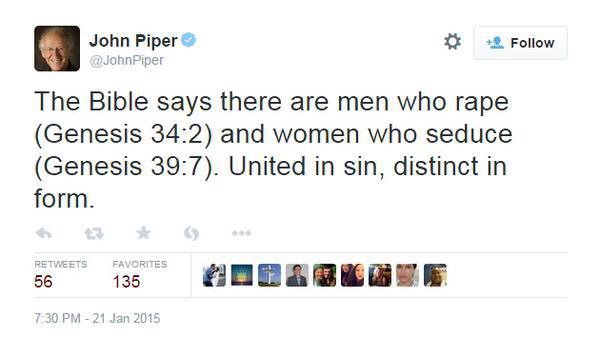
Oh, that John Piper…

Sorry if you are a fan of his, but I have to take issue with something he recently tweeted:

2015/01/img_1162-0.jpg

A friend on Facebook alerted me to it, and linked to the following discussion of the tweet. I felt compelled to weigh in with two comments:

The topic of rape, in my opinion, does not lend itself well to sound bites and tweets. I have no idea if this tweet of John Piper had any sort of context or if it just appeared willy-nilly out of thin air — but that is the very problem of Twitter in general. John Piper spends far more time there than I do, and one would think a pastor/teacher of his reputation would know better than that. Well, I keep thinking that and getting disappointed, and maybe someday I’ll wake up, smell the coffee, and simply say, whether it’s him or others of his ilk, “That wasn’t surprising—he often says things like that. That’s just the way he is.”

In the meantime, since I am not fully conversant with Piper-speak, only tending to run across him when he’s spread some other doozy all over the Internet, I am left trying to stay charitable while puzzling out his meaning. It seems to me as if he is saying, with the words “united in sin” and “two distinct forms”, that rape is the male version and seduction the female version of the same sin. Perhaps he refuses to believe that women can rape since there is no such thing recorded in Scripture. But the Bible does describe men seducing women AND it makes a clear distinction between rape and seduction.

I am tempted to say something disparaging about celebrity preachers and their lack of scholarship. (I’m a preacher’s kid whose father set the bar very high in that regard, and it has taken me years to stop getting dismayed and annoyed that few people take Scripture as seriously as he does.) But instead, I think I’ll make this observation: when it comes to the topic of rape, most men simply don’t get it.

The blog author had used a definition of the word “seduce” that referred to coffee, which inspired me to add the following:

An addendum: Coffee is extremely seductive to me. When I am at my weakest, it sometimes seeks me out, like a smooth-talking cad, luring me in sensuously, promising me unspeakable pleasures and delight. Were coffee-drinking a sin, I could try to avoid its siren calls and delicious scent. If forced to be around it, I could pray for strength to avoid its enticements. I could apply the Biblical admonitions regarding how to resist temptation. It would be silly for me to frequent coffee houses and surround myself with cups of coffee.

The Bible contains advice on how to avoid falling for seducers. That’s because, no matter how overwhelming seduction might feel, we always make a choice to allow ourselves to be seduced. We don’t say no. Instead, we say yes. The Bible does not tell us how to avoid falling for rapists. There is a definite distinction.

I drink coffee willingly. Yes, I was enticed, but I am not a victim of coffee. Coffee has never forced itself on me against my will.

For a seduction to succeed, it requires two willing participants, both of whom have sinned. Rape, by definition, has only one willing participant (unless there is more than one rapist) and he is the only one who has sinned.

Very different sins.

If John Piper is a man of integrity with a high view of Scripture, we can expect, very soon, a profound apology and correction.

Call me cynical, but I’m not holding my breath. John Piper has deleted his tweet, although as of yet without explanation, so perhaps I should try to be satisfied with that.